
What types of insurance do I need as a self-employed creative professional?
Your last day as an employee: you’ve turned in your laptop, handed back your ID card, and now that bag feels strangely light as you walk out the door. No paycheck that just shows up automatically. Instead, you have your first assignment, your own vision of what good work looks like—and a long list of things you now have to figure out on your own.
The question that then arises: what kind of insurance do I actually need? The answer doesn’t start with a list of policy names, but with three things that deserve protection: what could affect your work, the income that makes your work possible, and the resources you use to create it.
On your last day as an employee, you turn in your laptop, say your goodbyes, and walk out the door with a strangely light bag. No access card. No pay stub that will automatically show up next month. But you do have your first client, your own idea of what good work looks like, and a list of things you now have to handle on your own.
Then comes the question: What kind of insurance do I need?
The internet usually responds with long lists: general liability insurance, business interruption insurance, disability insurance, property insurance, cyber insurance, legal assistance, and transportation insurance. As if good entrepreneurship means covering every risk with a policy. For a creative freelancer, a different approach works better—don’t start with insurance terms, but with three things you want to protect: the people and things your work affects, the income that makes your work possible, and the tools you use to create.
Think of this as a roadmap that can evolve with your career, not as a mandatory shopping list.
Three types of protection provide more clarity than ten policies
Suppose you’re a photographer taking a portrait at a client’s office. During the shoot, a lamp could tip over and cause damage. If you get sick, you’ll lose income. If your camera is stolen, you might not be able to complete your next assignment. Three events, three different questions.
The first is liability: what if your work causes damage to someone else or their property? The second is income: how will you pay your fixed expenses if you’re temporarily unable to work or if assignments come in sporadically? The third is ownership and continuity: what equipment, inventory, files, or space do you need to keep creating?
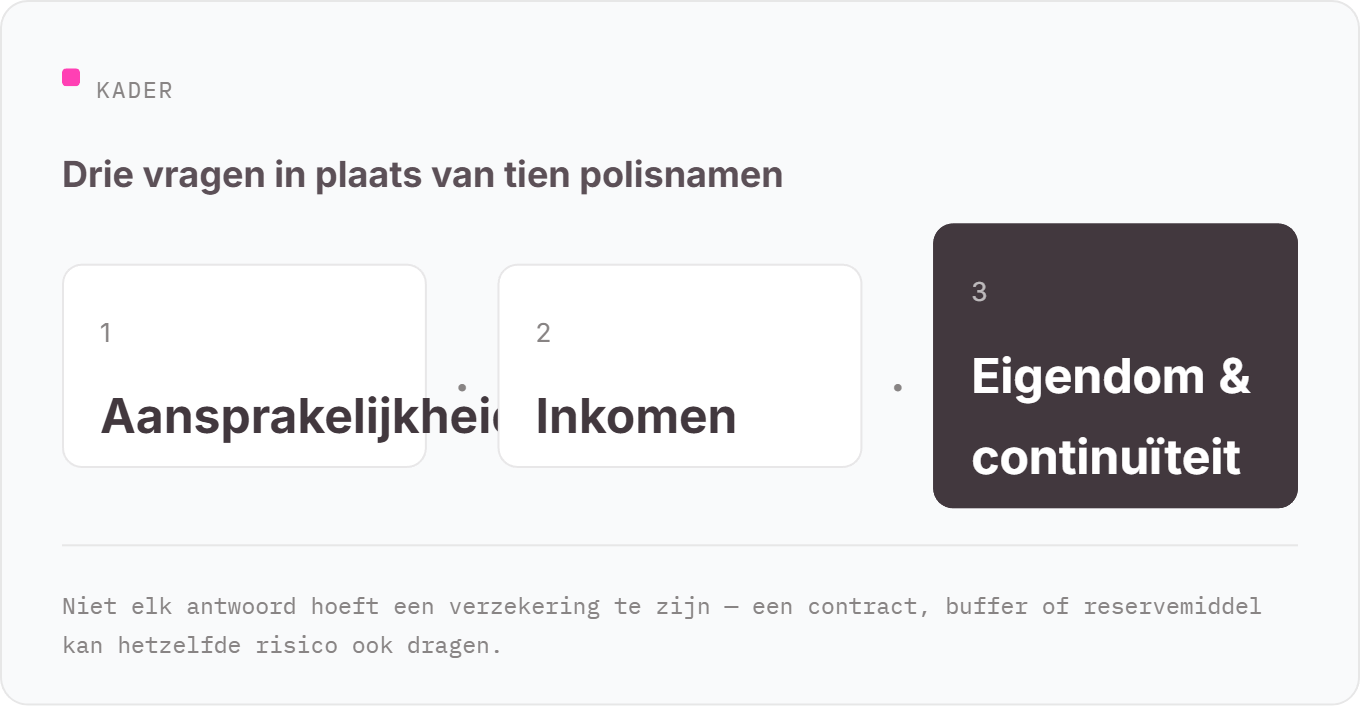
Not every answer has to be insurance. A clear contract can prevent a dispute over usage rights. A backup camera can save a day of shooting. A financial cushion can get you through a slow month. And insurance can cover financial consequences that are too large or too unpredictable to pay for yourself.
According to the Chamber of Commerce’s overview of insurance for startups, most business insurance policies are voluntary. Basic health insurance is mandatory for anyone who lives or works in the Netherlands; in addition, you pay into social insurance programs through your income tax. So the answer to “necessary” has two layers: what the law requires and what makes sense for your business practices.
In Year One: Protect What Can Directly Affect You First
A budding stylist often works on location, borrows furniture for a shoot, and moves racks through clients’ spaces. For her, business liability insurance makes sense early on. A copywriter who works exclusively from home handles fewer physical items and may prioritize coverage differently.
Business liability insurance is intended to cover damage to people and property resulting from your business activities, plus financial consequential damages when they fall under the coverage. Think of a visitor who trips over your cable or a tripod that damages a rented table. This is not the same as professional liability insurance: the latter covers financial losses resulting from a professional error—such as incorrect advice or a design flaw—without any physical damage occurring.
So first consider:
-
Do you work at clients’ locations, on sets, at events, or on construction sites?
-
do you use or move other people’s equipment;
-
do you deliver physical products or installations;
-
do you sometimes hire an assistant, intern, or other independent contractor;
-
does a client require general liability insurance in the contract?
If you recognize several of these points, read about how general liability insurance for creative freelancers addresses claims. Always check to make sure all your activities are listed on the policy. “Designer” can mean desk work, but it can also mean supervising a store installation. That distinction matters.
A financial buffer provides protection even without a policy
An illustrator receives payment for three invoices in March and none in April. She isn’t sick, nothing has been stolen, and no one is holding her liable. Her problem is timing. In such cases, a savings buffer is often more suitable than an insurance policy.
Nibud makes a useful distinction: in addition to a buffer for unexpected necessary expenses, if your income fluctuates, you’ll need an extra savings amount to cover lean months. The amount is personal. Add up your minimum personal and business expenses and determine how many months you want to be able to cover on your own.
Preferably, allocate funds by category:
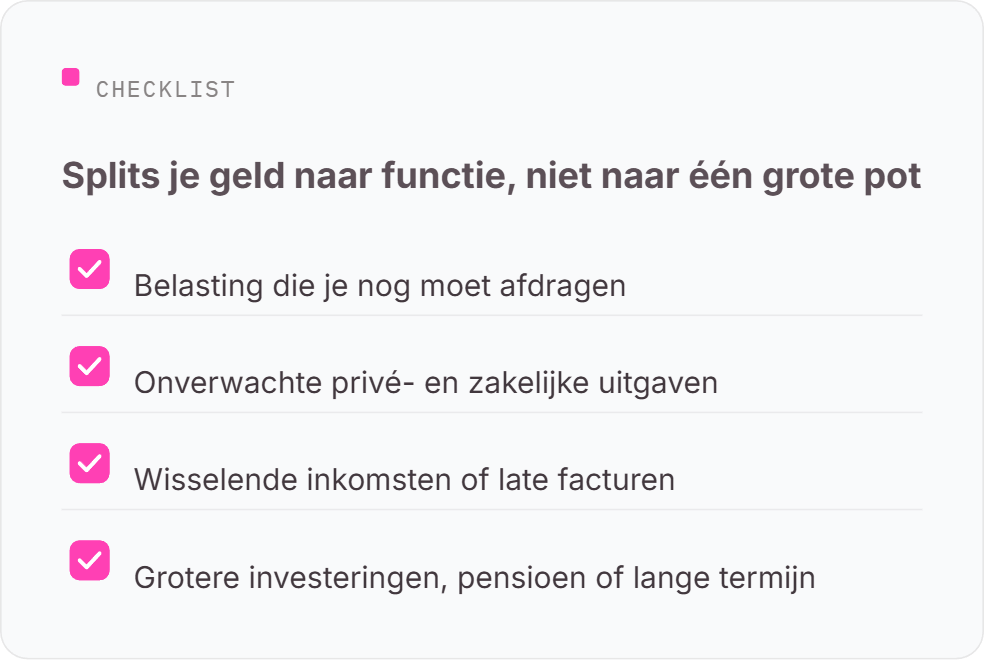
A savings buffer doesn’t prevent assignments from falling through. It gives you time to turn down a bad assignment. That provides both financial protection and creative freedom.
You can read more about saving for slow months. If you’d like to explore where to park your money afterward, Oddny Savings offers a guide to savings options through its partner, Raisin. Be sure to consider interest rates, liquidity, terms and conditions, and the bank’s deposit insurance program.
Protect your income if downtime lasts longer
A videographer with a three-month financial buffer can get through a slow winter. But if a back injury keeps you out of work for a year, the math changes. Savings cover a limited period; long-term disability may require a separate provision.
Options include disability insurance, a mutual aid fund or bread fund, and personal savings. They differ in terms of medical assessment, waiting period, policy term, benefit level, and conditions. Compare more than just premiums. Ask which occupation is assessed, when you’re considered unable to work, and how long you can continue to generate your own income.
The government is working on mandatory basic insurance for certain self-employed individuals, but as of the reference date of this article, September 16, 2026, it remains a proposal that requires parliamentary review and implementation. In the proposal, the national government specifies a gross premium of 5.4% of profits with a provisional maximum of €171 per month, a two-year waiting period, and a benefit of 70% of previous income, up to a maximum of the minimum wage. The government itself warns that both the percentage and the amount are still subject to change.
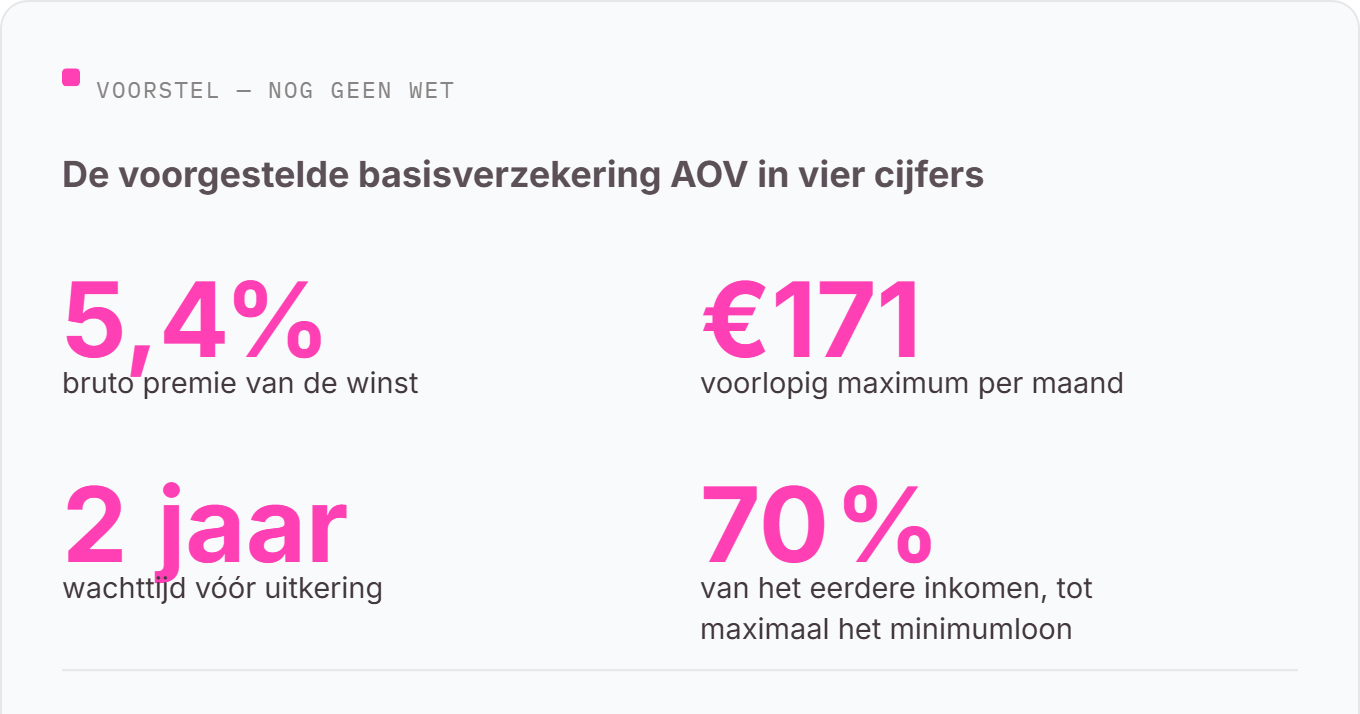
So don’t wait for future legislation to understand your current situation. Calculate what one, three, and twelve months without work would mean for you. Perhaps you need a larger financial buffer now. Perhaps you’d like advice on disability insurance. Perhaps you could still perform part of your work even if you’re physically unable to work. The answer starts with your body, your profession, and your financial obligations.
Starting in year two, your coverage grows along with your career
A graphic designer who created logos in year one is overseeing entire packaging lines in year three. A photographer opens a studio. A furniture maker sells their own line. Growth doesn’t dictate a single fixed supplemental policy; growth first changes the type of loss that’s possible.
Take a look at the new trends for each discipline:
Designers, architects, and consultants
Do you provide advice, calculations, or designs that a client relies on financially? If so, look into professional liability insurance. An error in a file can still result in repair costs or delays, even without physical damage. Pay attention to the definition of professional negligence, the coverage period, and the requirements in client contracts.
Photographers, videographers, and stylists
Do you work with expensive equipment, rented locations, or gear while on the go? Review your inventory, electronics, and transportation coverage. Verify that theft from a car, temporary storage, and work outside the Netherlands are included. A bag that appears to be insured at home may be treated differently during business travel.
Artists and creators
Do you have work, materials, or inventory in a studio? Distinguish between replacement value, market value, and unique value. Insurance may compensate for materials or market value according to the terms, but it cannot restore months of creative work. Fire prevention, proper storage, and up-to-date inventory lists therefore remain important.
Those Who Hire People or Manage Data
With your first employee, intern, or regular business partner, employer liability, absenteeism, and safety responsibilities become more pressing. If you store a lot of personal data or manage clients’ web environments, investigate cyber risks and, above all, make sure you have access controls, backups, and an incident response plan in place first.
Every step of growth warrants the same question: What am I doing now that I wasn’t doing last year? Be sure to communicate this to your insurer as well. Coverage can only apply to work that is known and accepted.
What do you probably not need?
A self-employed illustrator without a car, staff, or business space won’t benefit much from a package that bundles vehicle fleet, building, and group sick leave coverage. Yet such packages can sometimes seem reassuring because they list so many components. Just because there’s a lot doesn’t mean it’s right for you.
You probably don’t need insurance for a loss you can easily cover from your savings without having to stop working. Duplicate coverage doesn’t help either. For example, legal assistance may already be partially covered by a professional association membership, roadside assistance by a mobility contract, and equipment coverage by another business policy. Check this before adding any coverage.
Also, be specific about legal assistance. The name of a package says little about which disputes, areas of practice, and costs are actually covered. So read the terms and conditions for each situation. Oddny does not currently offer legal assistance insurance.
And don’t take out professional liability insurance just because the term “professional” sounds appealing. For some consulting professions or clients, it’s important or required; for other creators, the main risk lies in personal injury, property, or equipment. Read your contracts and ask what the client specifically requires.
Use this checklist for each new phase
When an interior designer takes on her first project with a contractor, both her revenue and her work context change. She works on a construction site, coordinates with multiple parties, and may be assigned responsibilities in contracts that didn’t apply to one-off consulting engagements. That’s the time for a new review.
Answer these questions at the start and at least once a year thereafter:
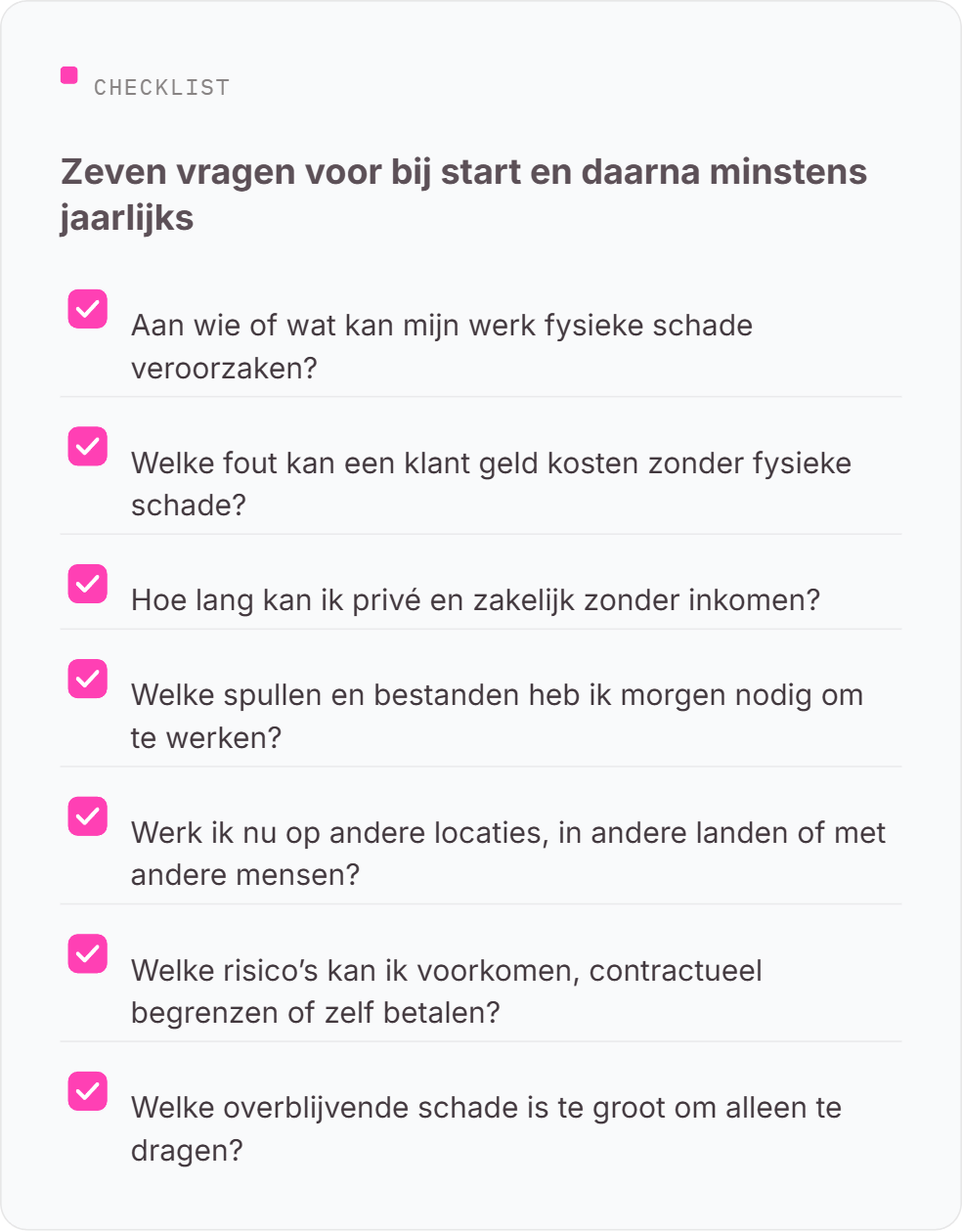
List one preventive measure next to each selected policy. Next to general liability insurance: secure cables and a site inspection. Next to equipment coverage: backups and serial numbers. Next to income protection: a recovery plan and a financial buffer. This way, insurance doesn’t replace vigilance—it complements it.
Start with your work; insurance comes next
For many self-employed creators, appropriate general liability insurance and an accessible financial buffer are logical first steps. After all, liability claims and fluctuating income can arise early in a career, though every work situation is different.
If you want to explore liability coverage, check out Oddny Liability Insurance. If you want to build a cushion for slower months, look into Oddny Savings. Both options start with the same simple question: what needs to be protected so you can keep creating?