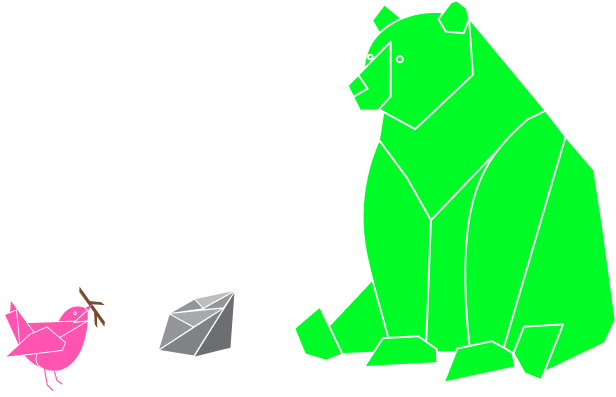
The Power of the Small: A Case for Swarm Intelligence in the Creative Sector
The Uncompromising Reality Most startups disappear. Fewer than half make it past the five-year mark. And what is even less often acknowledged: many scale-ups never truly break through either. They get stuck in an intermediate phase—visible, funded, promising—but without that moment when everything falls into place and sustainable returns materialize. Europe thus appears not so much to lack ideas, but rather to struggle to transform those ideas into mature, robust companies. That insight is slowly shifting the perspective. Not because the classic model is incorrect, but because it turns out to be incomplete. From company to ecosystem In response, the focus is shifting from the individual company to the ecosystem in which that company operates. Governments are increasingly investing in startups and scale-ups through subsidies, programs, and funds. But at the same time, there is a growing realization that isolated interventions are insufficient. The OECD emphasizes that sustainable innovation arises from coherence: talent, capital, regulation, knowledge, and infrastructure must align. The European Commission is also moving in that direction by not only supporting individual companies but also strengthening the broader playing field in which they operate. The revaluation of failure That may seem like a technical nuance, but it changes the way we understand progress. Instead of a linear process—start, grow, win—a picture emerges of a dynamic field in which many actors move simultaneously. In such a field, failure also takes on a different meaning. Whereas in the classical model it primarily serves as a selection tool, in an ecosystem it becomes part of a circular process. Knowledge, experience, and networks do not disappear when a company ceases operations, but move on to new initiatives. What appears to be lost fuels growth elsewhere. The swarm as a system From that perspective, a different picture of economic power emerges. It is not the single giant that takes center stage, but the swarm. Not the exception, but the multitude. It is the countless smaller companies, self-employed individuals, creative makers, and researchers who together form a network in which things are constantly shifting. They do not all continue to grow and do not all become large, but together they build a system that can adapt, recover, and renew itself. Precisely because it does not depend on a single player, but is supported by many. The creative sector as a driving force In this context, the creative sector occupies a position that has long been overlooked. Too often, creativity is seen as something added on top—a layer, a finishing touch, an aesthetic element that follows “real” innovation. But that view is shifting. The OECD shows that cultural and creative sectors are themselves sources of renewal and, moreover, drive innovation in other sectors. Creative professionals move between disciplines, bring different languages together, and open up new perspectives. They work not only within their own domain, but precisely at the boundaries between them. Transitions require imagination This makes them particularly important at a time when major challenges can no longer be addressed within a single field. The energy transition is not merely a technical issue, the food transition is not merely an agricultural one, and the healthcare transition is not merely a medical one. Every transition affects behavior, culture, and experience. Science can analyze and technology can build, but someone must translate it into everyday life. Someone must make it imaginable, understandable, and desirable. That is precisely where the work of designers, artists, architects, musicians, and makers lies. A new European movement It is therefore no coincidence that initiatives such as the New European Bauhaus, launched by the European Commission, explicitly link creativity, sustainability, and innovation. Not as a symbolic gesture, but as a practical necessity. Without imagination, innovation remains abstract. Without form, it remains inaccessible. Without experience, it is not integrated into people’s lives. A different definition of success This development calls for a reevaluation of what we mean by success. Scale remains important, and companies that continue to grow play a crucial role in economic development. But they are no longer the only benchmark. Progress also lies in the breadth of the system: in the quality of connections, the diversity of approaches, and the speed with which ideas can spread and transform. An economy that leaves room for many smaller players to experiment, collaborate, and influence one another develops a form of resilience that is difficult to achieve in a system that focuses primarily on a limited number of champions. The position of the maker For the creative sector, this means that it no longer needs to seek its position on the periphery of innovation, but can take its place at the very heart of it. Not by conforming to existing economic models, but by taking its own logic seriously. The logic of making, imagining, testing, feeling, and starting over. It is a way of working that is less linear, perhaps less predictable, but precisely because of that, suited to a world where change is the norm. From tower to landscape Perhaps that is why our times do not call for more giants, but for stronger networks of the small. For more space for creators, more cross-pollination between disciplines, and more trust in processes that cannot be captured in straight lines. From this perspective, the future does not appear as a tower that keeps growing taller, but as a landscape that becomes denser and deeper. Not as a competition with a single winner, but as a movement in which many contribute simultaneously. And within that movement lies a quiet but powerful promise: that progress arises not only from becoming bigger, but also from becoming more. Sources and inspiration This text is based on recent analyses and reports by, among others: Peter Guido de Boer