
Insuring Equipment as a Self-Employed Professional: Protect Your Tools
You recognize every little scratch on your equipment. That dent in the case, the tape on a lens—to you, every mark tells a story about a shoot or a performance. To someone else, it’s just a camera. To you, it’s the tool you use to make a living.
If you want to insure your equipment, you don’t need a policy right away—first, you need an overview. What do you own, where do you use it, and what would it be worth if it were gone tomorrow? Only then will it become clear which coverage is truly right for you.
You know your equipment inside and out. That scratch on your camera reminds you of a winter shoot; the tape on a case reminds you of a performance where everything had to be set up in a hurry. To someone else, it’s just a camera, a drill, or a synthesizer. To you, it’s the tool you use to work, create, and earn a living.
Anyone searching for “insuring equipment as a self-employed professional” doesn’t necessarily need an insurance product right away—they need an overview first. Where do you use your equipment? At home, in a studio, at a client’s location, or on the road? Is it sometimes stored temporarily? Different conditions and risks may apply depending on the situation.
So first, take stock of what you own, where you use it, and what it’s worth. Then you can determine which coverage is right for you: for example, inventory insurance, electronics insurance, tool insurance, or another solution.
What counts as equipment and what counts as inventory?
Ondernemersplein defines inventory as everything a business uses to carry out its work and that is not intended for sale. Examples include computers, desks, chairs, and tools. For a photographer, cameras and lenses are part of those work tools; for a videographer, lighting, sound equipment, and storage are also included; for a furniture maker, machines and hand tools.
Inventory is something else. Prints you sell, materials that go into a customer’s product, and a stack of merchandise are all considered goods. According to the same government interpretation, a vehicle or trailer also does not fall under the standard definition of inventory. A single studio can therefore contain inventory, electronics, stock, and transportation all in one place, while an insurance policy breaks these down into separate categories.
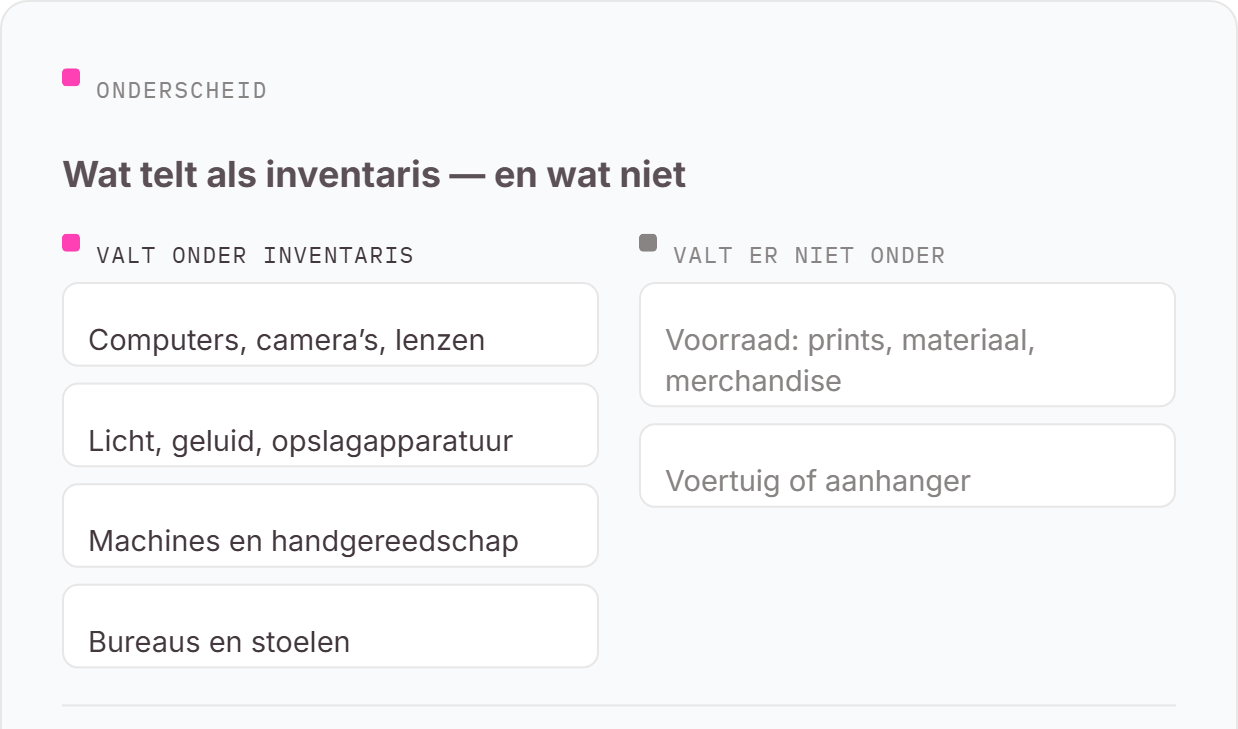
Make a list by category. Don’t list “camera equipment €12,000,” but rather list the camera body, lens, flash, laptop, memory cards, and accessories separately. This way, you can also see which two components would immediately bring your work to a halt if they were missing.
General liability insurance usually doesn’t cover your own camera
General liability insurance covers damage your business causes to others or their property. If a lighting stand breaks a table at a client’s location, that may fall under general liability coverage. If you drop your own camera, however, no one else’s property has been damaged.
This distinction prevents a common misconception. “I’m insured for damage to property” doesn’t specify whose property is meant. Read the Oddny page on liability to understand how general liability insurance is defined, and then check your own policy terms.
Property insurance is not required by law. According to Ondernemersplein, such a policy typically covers damage to business property caused by fire, water, storms, vandalism, and theft. “Usually” is the key word here. Electronics may be covered, but certain equipment may require separate insurance. Poor maintenance, intentional damage, and some natural disasters are listed in the government’s general guidelines as common exclusions.
Owned, borrowed, and rented are three different categories
Assign one letter to each item: E for owned, L for borrowed, and H for rented. The camera you own may be covered under your inventory or equipment coverage. A colleague’s lens and a supplier’s rented amplifier are owned by someone else but are temporarily under your supervision.
That’s precisely where an exclusion may apply. In liability insurance, this is often referred to as “damage to property under supervision”; in rental agreements, the lessor may require their own coverage, a security deposit, or a liability clause. Ask before use:
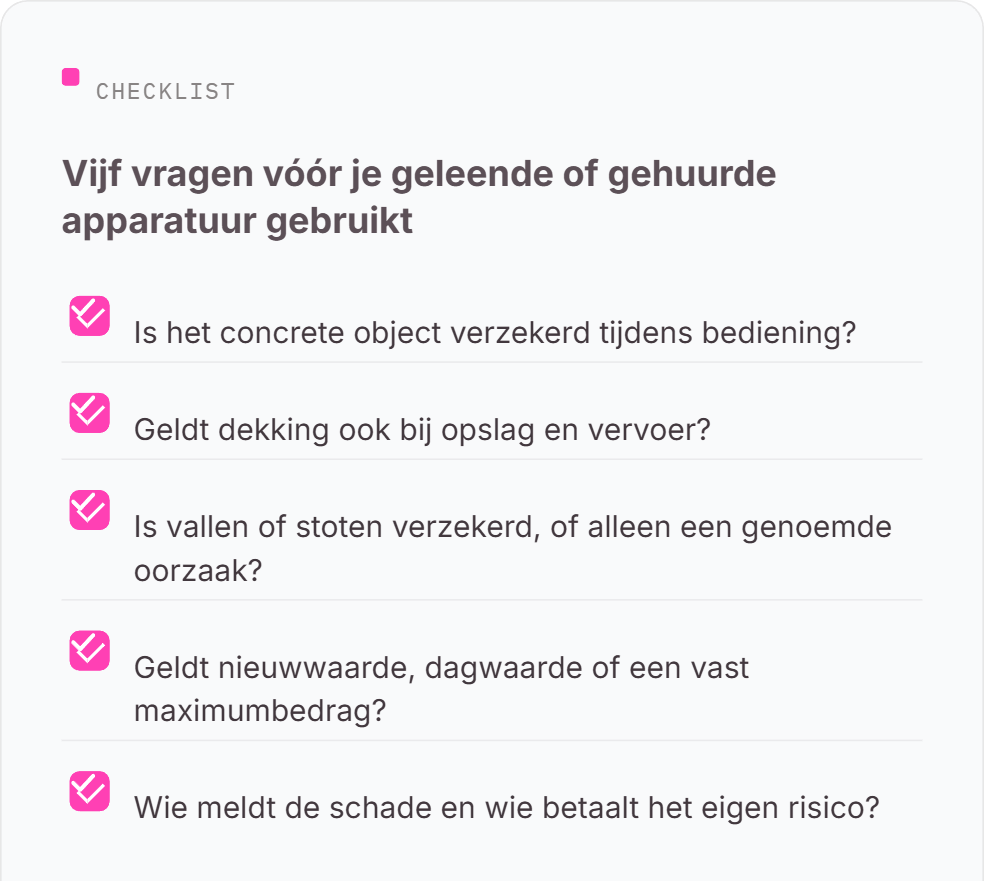
Compare the answers with the rental agreement. A contract can hold you liable even if your policy doesn’t cover that obligation. Have broad or unclear clauses reviewed in advance.
Keep track of five locations: home, studio, location, transportation, and storage
A policy that works for your studio doesn’t automatically apply when you’re on the go. Set aside one workweek and map out your equipment’s route. A photographer leaves from home, picks up an assistant, works at a hotel, and leaves suitcases in a locked van during lunch. A musician rehearses in a shared space and stores gear at a bandmate’s place after midnight.
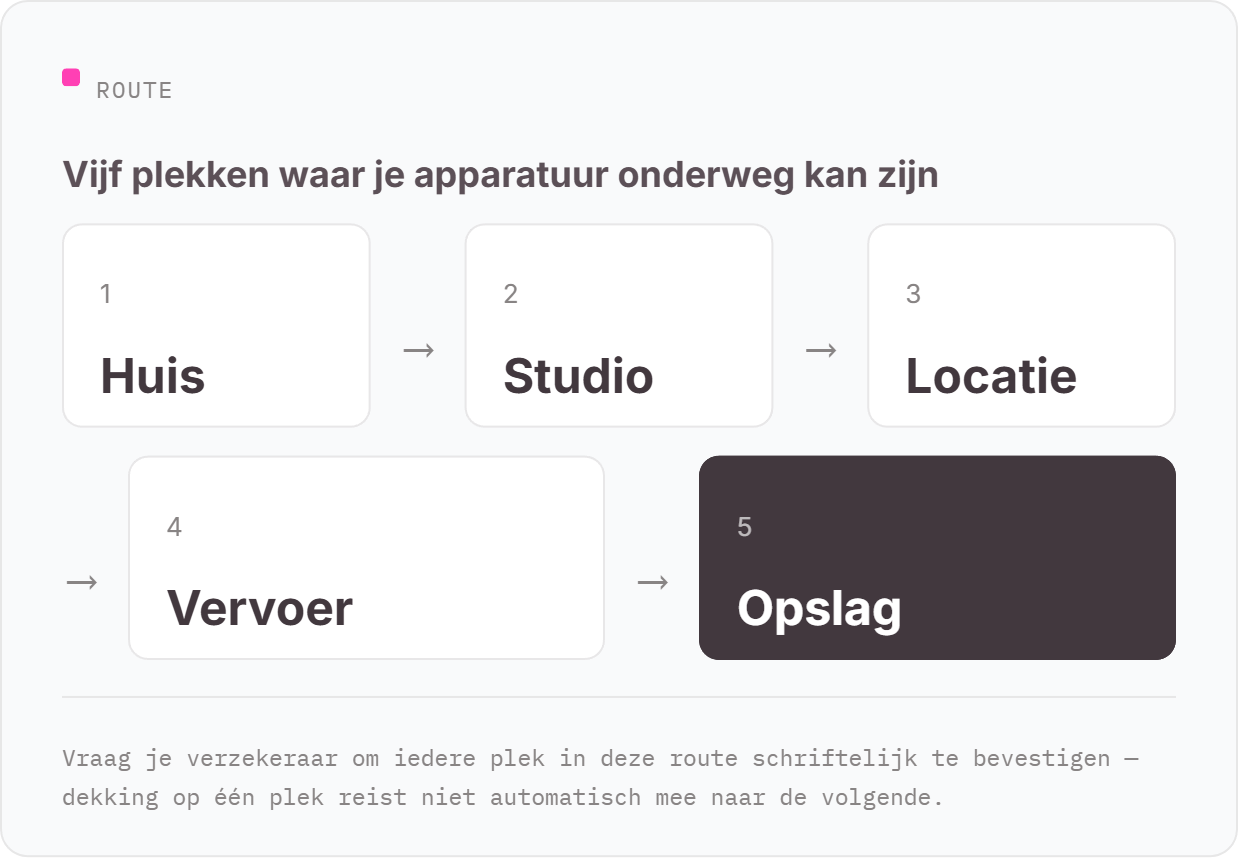
For each location, ask about the following conditions:
-
Is this location listed on the policy?
Does coverage apply outside the business address?
What requirements apply to locks, signs of forced entry, and surveillance?
Can equipment be left in a vehicle overnight?
Is transportation covered, and in which countries?
Make assumptions clear. “Insured off-site” may mean something different than transportation, temporary storage, or leaving equipment unattended. Ask the insurer to confirm your actual route in writing.
For specific location scenarios, you can also look at what a photographer might encounter on location and how videographers manage risks on set. Those articles are about liability, but they do help clarify the distinctions between people, places, and equipment.
Theft and damage require proof before anything happens
Create an inventory list including brand, model, serial number, purchase date, purchase price, and current replacement value. Include photos and receipts. The police recommend always recording serial numbers and suggest using the Stopheling app as a permanent storage location. A serial number makes a product unique and traceable. According to the police, only products reported as stolen on or after January 1, 2010, are listed in the Stopheling registry.
Store the list somewhere other than the laptop on which it is saved. Share a secure copy with yourself or a trusted person, and update it after every major purchase or sale. Immediately check whether the total value still falls within the insured amount and whether valuable individual items have their own coverage limits.
In the event of theft, the insurer often requires a police report and proof of ownership. In the event of damage, photos of the situation, a repair estimate, and the lease or contract will be helpful. Do not acknowledge liability to another party on your own initiative before you have read the reporting instructions.
Protect what’s not in the case, too
New hardware does not replace images, designs, recordings, or customer files. Insurance may reimburse you for a device, but a lost project file requires restoration from a backup.
The National Cyber Security Center recommends the 3-2-1 rule: keep three versions of important data on two different types of media, with one copy stored in a different location. Also test whether you can actually restore your data. A folder named “backup” is only a backup if you can restore it.
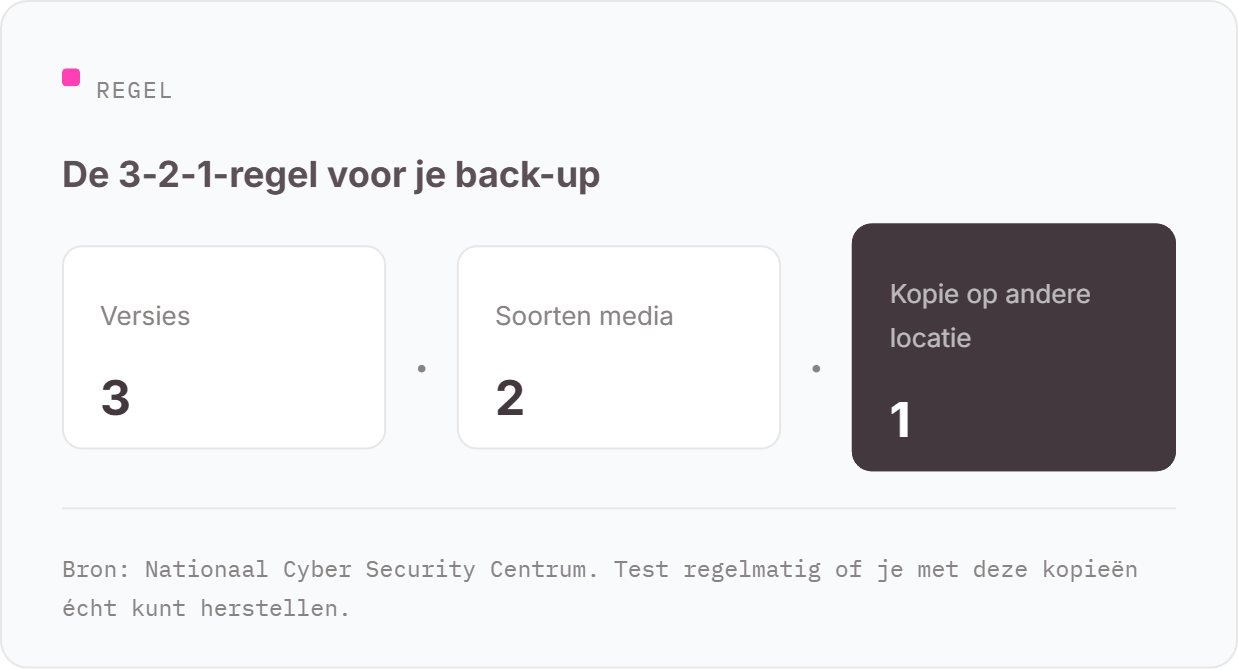
Therefore, combine two routines: update your inventory list monthly and perform a recovery test regularly. One document proves what you had. The other preserves what you created with it.
Insuring equipment as a self-employed professional starts with the entire process
Pick five items you’ll need tomorrow. Note the owner, replacement value, locations, and the consequences if they were missing for a week. Then present that route to your insurer or advisor. Make the question “Is my equipment insured?” more specific: this rented lens is traveling by train to Belgium and will stay in a hotel safe for two nights.
For equipment, appropriate protection depends heavily on the items and their route. For the general liability insurance (AVB) portion, you can review the liability coverage. If you’d like to discuss your situation in plain language first, use Oddny’s contact page. You don’t need to know the exact policy name yet.
Your tools bear the marks of the work you’ve already done. Good protection, above all, preserves the possibilities for what you’ll create with them tomorrow.