Risks of Being Self-Employed: What Can Go Wrong in Creative Work?
The briefing is ready, the venue is booked, and the client has finally said yes. For the first time, you’re bringing an assistant along—a sign of growth. But it also means more moving parts that fall outside your own field of vision.
Risk as a freelancer often sounds like a list of disasters. It isn’t. It’s about the gap between what you plan and what actually happens during the project—a gap you can narrow, distribute, or consciously shoulder yourself.
The briefing is clear, the venue is booked, and the client has finally given the go-ahead. For the first time, the assignment is big enough to bring an assistant along. That feels like growth. It also means that more aspects of your work fall outside your immediate scope.
Risks as a self-employed person often read like a list of disaster scenarios. That doesn’t help. Here, we’re talking about risks in your day-to-day work, not the tax-related question of whether an assignment qualifies as self-employment. A good risk assessment is more like reading a briefing: what are you going to create, who does what, what materials and data will you use, where are the dependencies, and what can you agree on in advance?
Risk isn’t proof that you’re being reckless in your business. It’s the gap between your plan and what actually happens during the project—a gap you can narrow, distribute, or consciously take on yourself.
Liability: Your work affects the world around you
A photographer sets up a lighting stand in a hotel lobby. A guest steps backward, trips over a cable, and gets injured. Or a set builder drills through a client’s pipe during an installation. The work was carefully prepared; yet, damage is caused to a person or property.
That is general liability. Personal liability insurance is not intended to cover damage you cause while conducting business. A general liability insurance policy can, within its terms and conditions, cover property damage, personal injury, and the resulting financial consequences.
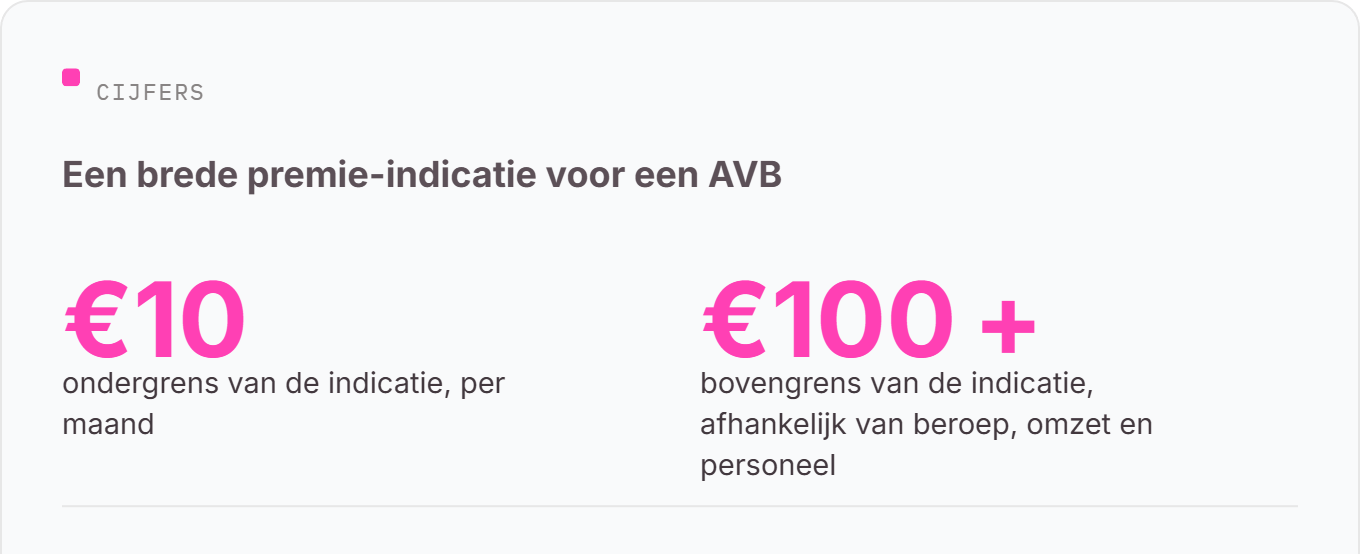
How often such incidents occur varies greatly by profession. An illustrator who works from home has a different risk profile than a stylist working at events. Costs also vary: a scratch on a table is relatively minor, whereas an injury can have long-term financial consequences. The Chamber of Commerce (KVK) provides a broad estimate for general liability insurance premiums ranging from approximately €10 to over €100 per month, depending on factors such as profession, revenue, and staff. This is only a premium estimate; your specific activities will determine the actual risk.
Start with practical steps: secure cables, take photos of a venue before setup, agree on safety roles, and report new activities to your insurer. Also find out who is responsible for paying in the event of damage to your work or your client’s property. Prevention starts with identifying what could affect your hands, equipment, and employees.
Income: A full schedule isn’t a safety net
A self-employed animator breaks his wrist and can’t draw for six weeks. His assignments don’t disappear immediately, but deadlines are pushed back, a client looks for a replacement, and new requests pile up. The financial loss isn’t reflected on a single invoice—it extends throughout the calendar.
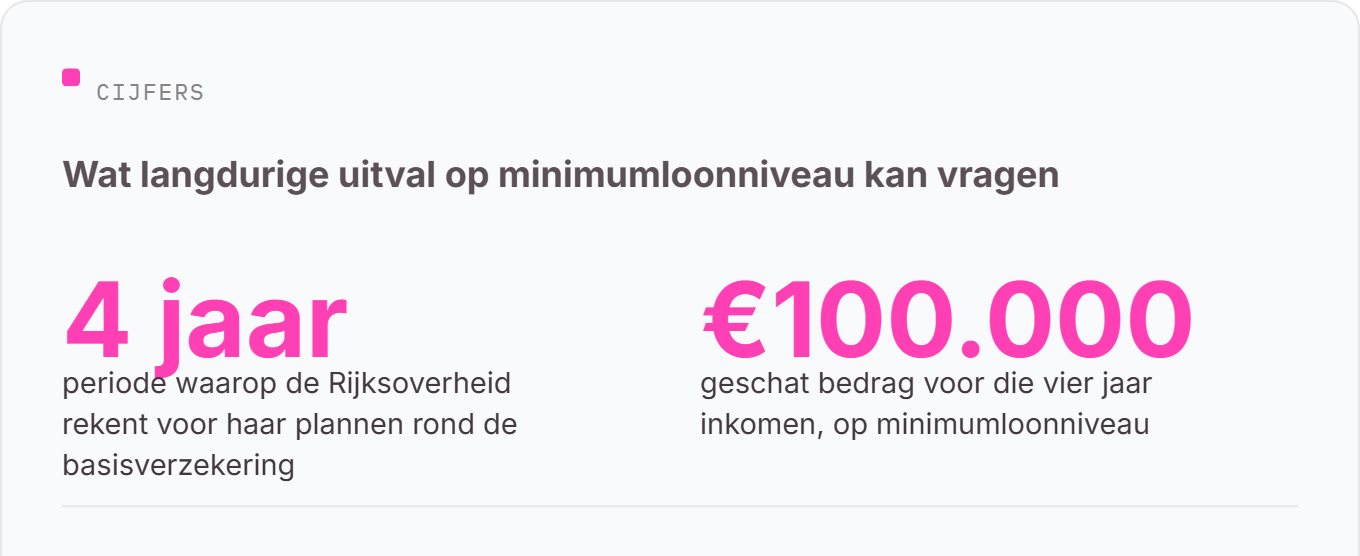
For the self-employed, income during illness isn’t automatically covered by an employer’s plan. How significant this risk is depends on your fixed expenses, how much work you can postpone, whether someone can take over your tasks, and how much of a financial buffer you have. In its plans regarding basic health insurance, the national government estimates that four years of income at the minimum wage level amounts to approximately €100,000. This is not a prediction for your specific situation. However, it does illustrate why a long-term absence is different from a slow month.
Determine three specific amounts: your minimum personal expenses, your business fixed costs, and how much you can postpone each month. In addition, build a separate buffer for fluctuating income. Disability insurance, a support group, or another provision may be suitable for long-term absence; a savings fund, on the other hand, helps with shorter gaps and your own waiting periods.
Growth can sometimes make this risk less apparent. As revenue increases, so do studio rent, software costs, and client expectations. Therefore, look at what you’re earning now and what needs to keep coming in each month.
Ownership: A camera, file, or design can go missing
After a day of shooting, a videographer leaves two memory cards on the train. The cards themselves cost very little. The footage, however, represents three weeks of preparation, a rented location, and a team that won’t be readily available again.
Ownership, therefore, involves more than just the purchase price of equipment. It also involves inventory, client work, source files, and the ability to continue production. For a ceramic artist, the vulnerability might lie in a kiln. For an architect, in a laptop containing current project files. For a photographer, in lenses and backups.
For each important resource, note what it would cost to replace it and how many workdays you could go without it. Following the 3-2-1 rule, make multiple copies of your files on different types of storage media, with one copy located outside your workplace. Also test whether you can actually restore a backup. A folder labeled “backup” is not a recovery plan.
Inventory, property, or electronics insurance may be appropriate if you don’t want to bear the replacement costs yourself. In that case, check the coverage for location, transportation, theft conditions, and valuation. Some items are technically replaceable but practically indispensable. That distinction should inform your choice.
Reputation: Trust Can Be Damaged Without Anything Breaking
A designer accidentally emails a presentation containing client data to the wrong contact person. No camera was broken and no set was knocked over. Still, she must act quickly, provide an explanation, and assess whether personal data has been leaked.
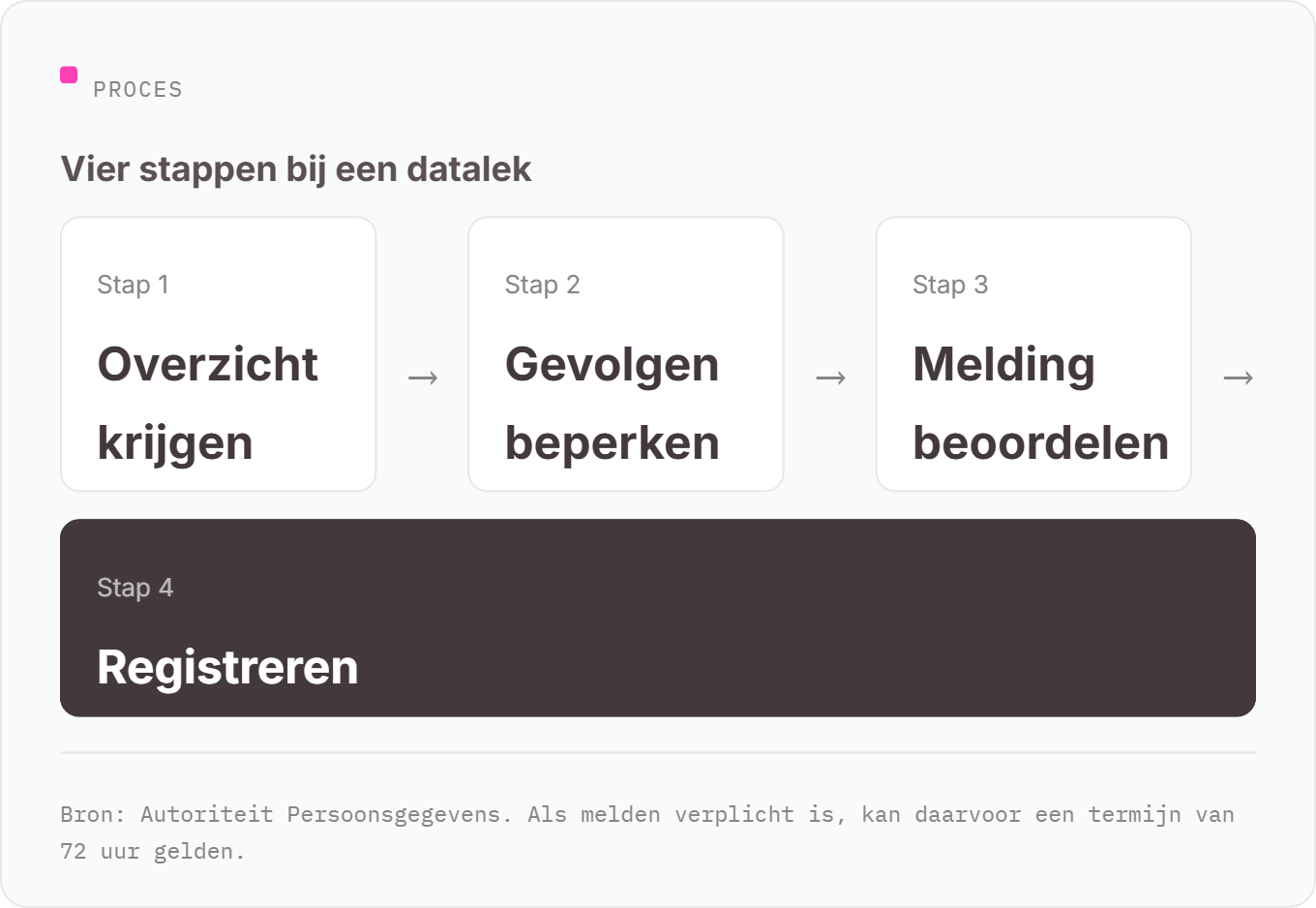
The Dutch Data Protection Authority outlines four main steps in the event of a data breach: get an overview, limit the consequences, assess whether a report or notification is required, and record the incident. If reporting is mandatory, there may be a 72-hour deadline. Speed helps here, but preparation helps even more.
Use two-factor authentication, restrict access to client folders, agree on who is authorized to share files, and maintain a simple incident response plan. You don’t protect your reputation by promising that nothing will ever go wrong. You protect it by visibly acting with care when it does.
A substantive conflict can also damage your reputation. Consider issues such as ambiguity regarding credits, a portfolio mention prior to launch, or the use of images outside the agreed-upon license. Therefore, include publication timelines, rights, and confidentiality provisions in your agreement. This safeguards both the work and the relationship.
Preventing damage starts before the first day of work
A graphic designer who lands her first major retail chain as a client can clarify a lot in just half an hour. Who approves the work? What files does she deliver? Who checks the text and dimensions? What happens if additional work is required? When can the project be included in her portfolio?
Use this quick checklist for every major assignment:
-
Write down tasks, scope, and approval milestones.
-
Establish payment terms, cancellation policies, and usage rights.
-
Make a list of people, equipment, locations, and data that could be affected.
-
For each risk, choose: prevent, mitigate, pay out of pocket, or insure.
-
After your business grows, check whether your agreements and coverage still fit your needs.
This last point is especially important when you hire your first employee, open a new studio, purchase more expensive equipment, or take on work abroad. A policy that was suitable for logo design from home may no longer be appropriate once you start designing retail interiors as well.
When does insurance align with business risk?
Don’t automatically insure everything that feels like a hassle. Consider two factors: how significant could the financial loss be, and can you cover it yourself without shutting down your business?
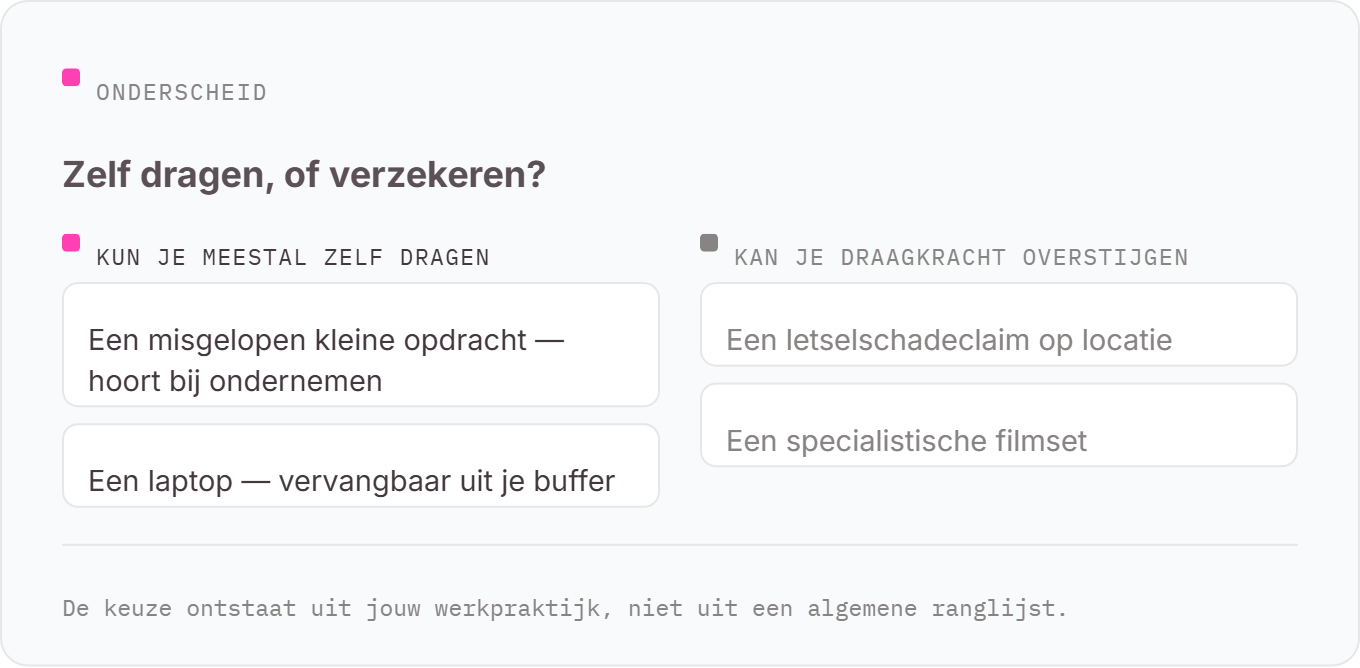
You usually can’t insure a small job that didn’t pan out—that’s just part of running a business. A personal injury claim on site could far exceed your financial capacity. You might be able to replace a laptop using your savings, but not a specialized film set. The choice stems from your actual work practice, not from a general ranking.
For physical injury to others, general liability insurance for creative self-employed professionals is a logical first step. Be sure to review the exclusions, deductible, coverage limit, and the activities listed on the policy. Insurance does not replace your contracts, safety checks, or backups. It covers a portion of the risk that you shouldn’t reasonably bear on your own.
Start with liability, but start with your work
Pick one recent assignment and review it as a risk assessment. Where did you work on-site? What items belonged to someone else? What information did you receive? What would happen to your income if you were unable to work for a month?
If injury to people or damage to property is the first risk you don’t want to bear yourself, you can take your time to review Oddny’s liability insurance and then use the premium calculator to see what fits your line of work. You don’t have to make a choice out of fear. You just need to look closely enough.