PROOF OF GENIUS #08 — PERFORMANCE
PROOF OF GENIUS #08 — PERFORMANCE
When the Body Takes Over Language
A performance by Jana Jacuka doesn’t begin with the question of what you’re supposed to understand. In fact, it’s best not to. It begins with presence. A body, a voice, a space, and an audience that doesn’t remain safely at a distance but inevitably becomes part of what’s happening.
Jacuka is a choreographer, creator, and performer. She moves between performance, theater, and choreography and often works with little more than her own body and voice. No set to distract the attention, no technology to get in the way. Her work explores what happens when words lose their usual meaning and sound, movement, breath, and physical proximity take over. On her own website, she frames it almost as a principle: she creates work that is meant to be felt rather than understood.
And that’s exactly where it gets interesting. Because how do you create something that is carefully constructed yet only truly comes to life when something happens that you can’t fully predict in advance?
At a Glance
Creator
Jana Jacuka, choreographer, performer, and artist, with Latvian and Dutch roots and based in Amsterdam.
Practice
: Performance, choreography, and voice research, in which the body, voice, space, and audience collectively shape the work.
Education
: Contemporary Dance Art Studies at the Latvian Academy of Culture and a master’s degree at DAS Theatre in Amsterdam.
Work
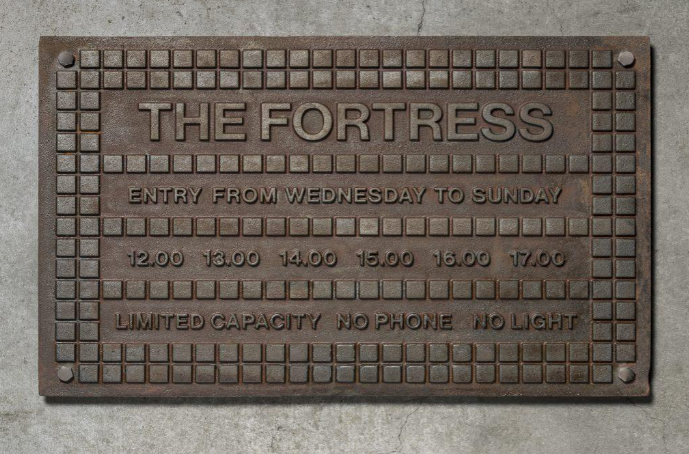
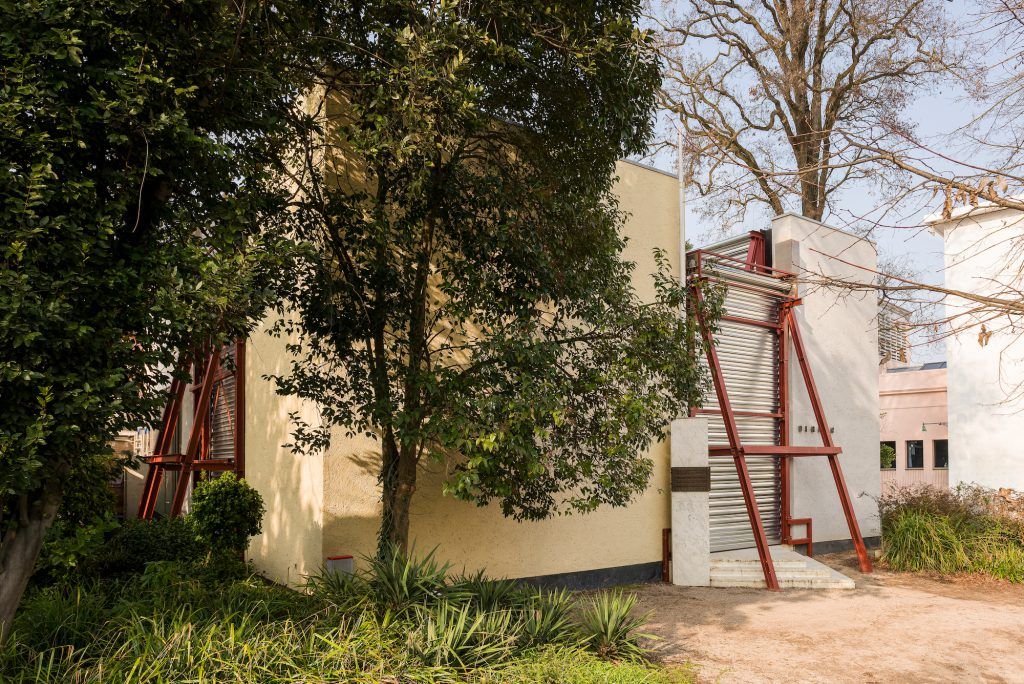
Includes HA, in which laughter and extreme vocal techniques become choreographic material, and her involvement in The Fortress at the Dutch Pavilion during the 61st Venice Biennale.
Unfair Advantage
Treating the voice as an extension of the body.
The challenge
: Combining complete presence with the unexpected—maintaining control without over-regulating everything.
You don’t have to understand it right away
Performance art demands something remarkable from its audience. With a painting, you can walk right past it. With a book, you can close it. With music, you can let your mind wander if you need to. But when a performer shares a space with you, the relationship changes.
You’re there.
And Jana finds that essential. For her, the audience isn’t just a collection of random bystanders. The physical and emotional interaction between performer and spectator is one of the binding elements of the work. Your presence changes the space and, with it, the performance. Even when no one is asked to step onto the stage or literally do anything, you’re participating.
That can be uncomfortable. Performance sometimes invites you to temporarily set aside the familiar rules of watching. You don’t know exactly what’s expected of you. There’s no manual explaining when to laugh, where to look, or what something means.
That discomfort isn’t a flaw in the system. It’s part of the system. Jana seeks to transport the audience away from a world in which language must constantly be understood, interpreted, and explained. Instead, a space emerges where movement, sound, rhythm, and physical sensation carry meaning. Not everything has to pass through the mind first. Sometimes the body understands what’s happening sooner.
When a voice ceases to be language
Jana’s work borders closely on dance and choreography, but a second body emerges in her work: the voice. Not the voice as a vehicle for polished sentences, but as a physical force.
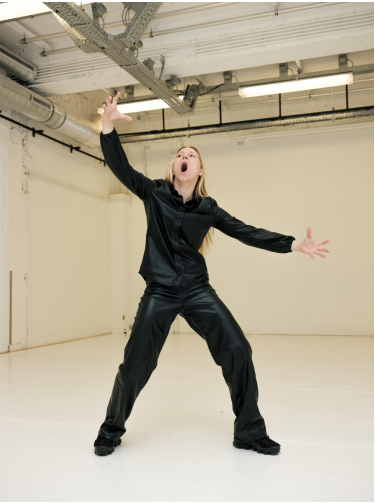
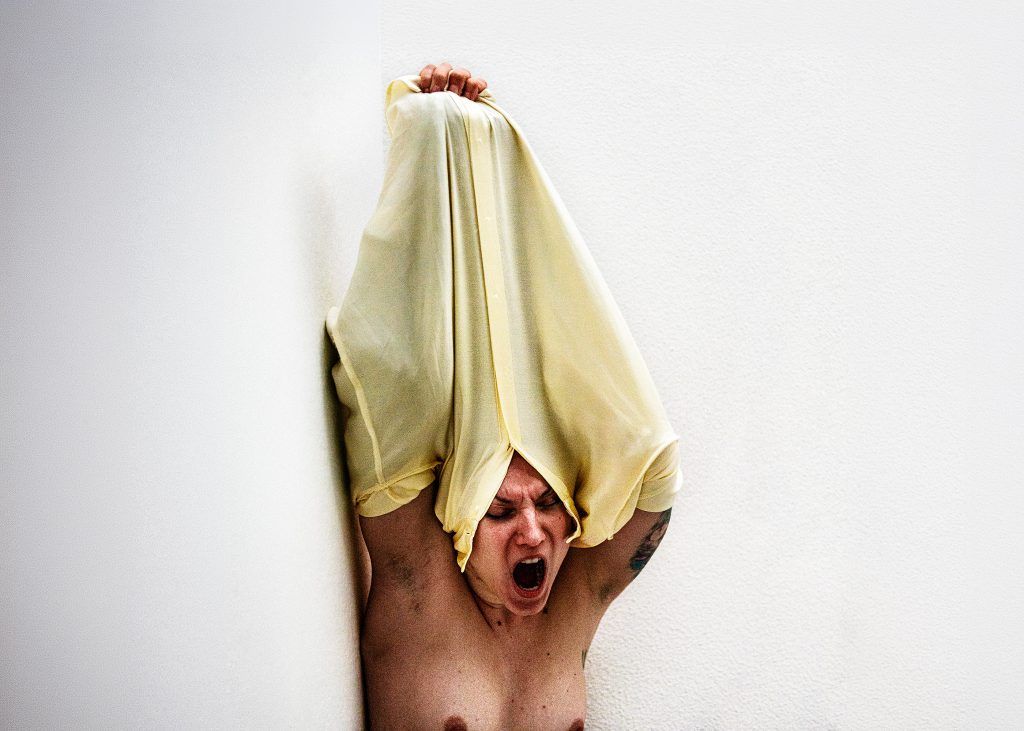
In HA, she explicitly explores the voice as a choreographic tool. She grunts, fry-screams, speaks while inhaling, and moves toward a form of communication beyond ordinary words. The voice literally becomes an extension of her body. This also changes the way you listen.
A scream is not a sentence. A breath has no grammar. A vibration in the chest cannot always be translated. Yet such a sound can immediately evoke a response.
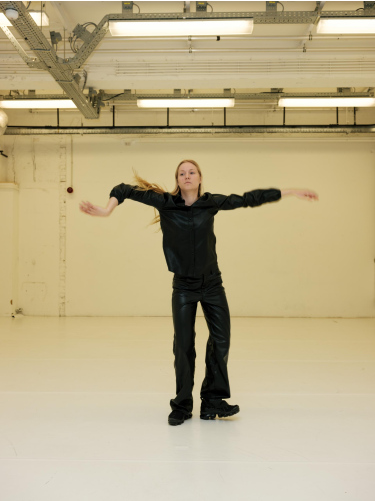
Then there’s the space itself. A performance never takes place exclusively within a hall; the hall itself participates. Height, distance, hard walls, bodies, silence, and acoustics alter what a voice does. The space becomes a sound box.
This creates something that is difficult to categorize in traditional terms. It is not a concert, not a dance performance, and not a play, although it may contain elements of all three. Its vocabulary consists of bodies.
The best moment is when something breaks
Ask Jana when a performance truly becomes good, and her answer doesn’t lie in flawless mastery. She actually feels at her best when something unexpected happens.
Something breaks. A movement goes differently. The voice doesn’t respond as expected. A situation changes. Suddenly, she has to find a way on the spot to accommodate that new development and carry it forward.
Remarkably, she doesn’t primarily experience this as negative stress. It creates a kind of positive tension: maximum alertness. That’s precisely when the work comes to life for her. That might sound like a loss of control, but Jana doesn’t see it that way. She doesn’t lose herself in the performance. On the contrary. Her mastery lies precisely in her ability to deal with the uncontrollable.
Perhaps that is a special form of mastery: not bringing everything under control, but possessing enough control to immediately transform something that goes off the rails into new material. A tear does not become a failure. The tear becomes an opening.
Creative destruction
In this way, her work comes close to what you might call creative destruction—but literally embodied in the body.
A movement is explored for so long that it reaches its limit. A voice is stretched until it no longer sounds like a voice should sound according to our normal expectations. Meaning breaks down, and precisely because of that, new territory emerges.
Jana speaks of herself in this context as a kind of shepherd. It’s an interesting image—not because an audience would follow mindlessly, but because someone is guiding a collective movement whose final destination isn’t entirely fixed. The performer sets something in motion. The audience moves along with it, both physically and emotionally. That requires trust from both sides. The creator must dare to let go of what was planned in advance. The audience member must accept that they don’t always know exactly what’s happening. Perhaps that is the minimum price of admission to performance: surrender. Not understanding, but remaining present.
A voice that at first didn’t want to scream.
Jana’s relationship with the voice also has a personal history.
Her artistic roots lie partly in Latvia, where she studied Contemporary Dance Art before later moving to Amsterdam. She recounts an experience that, in hindsight, reads almost like a founding moment for her current practice.
She goes into the woods alone to try to scream. That sounds simple. It doesn’t work. No free, uncontrolled cry comes out. As if the voice is still trapped in a system of control and obedience. Jana herself connects this to a culture in which you learn to restrain yourself and in which obedience can run deep.
A voice suddenly turns out to be much more than a biological instrument. It carries with it upbringing, conventions, and memories. Learning to scream thus becomes almost an act of liberation—not as therapy in the clinical sense, but as an artistic exploration of everything the body holds onto without us being constantly aware of it. Years later, that very voice becomes one of the most powerful elements in her work.
Everything is real
Another striking element of Jana’s practice is its almost radical physicality.
During the performance itself, she does not want to place any technological layer between herself and the audience. No microphone that amplifies the voice beyond its physical limits. No digital aid that replaces physical effort. The body produces the sound. The space amplifies or absorbs it. The audience receives it. That’s all. That is precisely what makes performance vulnerable.
When the voice fails, there is no backup instrument in a case. If a body becomes exhausted, you cannot plug in a new one. Illness, fatigue, or an injury immediately affect the ability to perform.
Jana also literally notices where her limits lie. Performing three days in a row is about the maximum; after that, she needs a few days to recover. The artwork and the body that creates it are inseparable here. That’s beautiful.
From a business perspective, it’s also quite confrontational.
The work exists—and then disappears
That transience presents yet another problem. How do you build a portfolio of something that no longer exists once it’s over? According to Jana, setting up a camera at the back of the hall and pressing “record” doesn’t work. A recording must be made with great care. That’s why she collaborates with professional filmmakers and discusses in advance how image and sound can capture the performance. But at the same time, she draws a clear line.
The recording is not the performance. A recording can document what happened. It can preserve impressions, make the work accessible to programmers, and showcase a body of work. But that same physical exchange between performer, audience, and space is gone.
A recording is proof that the work existed. It is not the work itself. In an age when nearly every cultural moment is instantly transformed into digital content, that distinction becomes all the more interesting. Jana creates something whose complete version cannot be saved.
The Irony of Entrepreneurship
And then the world outside the performance comes back in.
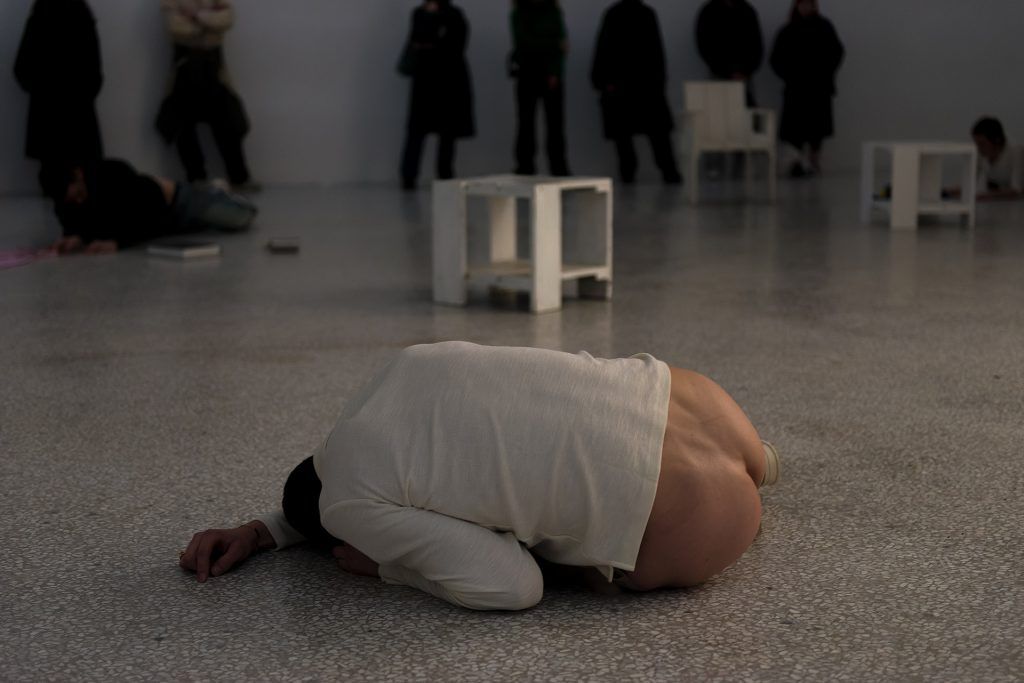
Jana works internationally. She creates her own pieces, performs in others’ works, and moves between festivals, theaters, and exhibition contexts. Her résumé now includes a wide range of international projects and awards. In 2026, she will be involved—among other roles—as a performance advisor and occasional performer in Dries Verhoeven’s *The Fortress* at the Dutch Rietveld Pavilion during the Venice Biennale. The performative material there is developed in co-creation with the performers. Artistically, she handles uncertainty with ease. Financially and legally, however, that world feels much less familiar. Risks, insurance, international regulations, income when you can’t perform: for her, it’s largely uncharted territory.
There’s a curious contradiction here. An artist may know exactly what her body can handle, how far her voice can be pushed, and how she’ll react when something unexpected happens in the middle of a performance. At the same time, a tax rule, insurance policy, or contract in another country can feel completely inscrutable. Perhaps that’s not so strange after all. Creative freelancers are trained to master their craft. Hardly anyone teaches them how to manage the vulnerability surrounding that craft.
For a performer, that vulnerability is just exceptionally visible.
When the body stops, the work stops.
HA: almost nothing, and therefore everything
HA is perhaps the clearest illustration of Jana’s way of thinking.
The starting point is laughter: something mundane that everyone is familiar with. But Jana explores laughter as an escape mechanism when boundaries are crossed in everyday situations. Then, the laugh is taken apart. The H. The A. Breath. Sound. Voice. Body. Theatrical distractions are eliminated as much as possible. What remains is she, the space, and the audience. On paper, that sounds like almost nothing. In performance, that nothing can become enormous.
Her next work, tentatively titled AAA, continues to explore the voice as a choreographic process. Among other things, yodeling—precisely because of the instability and sudden shifts in the voice—serves as new material for exploration. According to her current schedule, the premiere is set for May 2027 at the SPRING Festival in Utrecht.
The direction is clear: don’t add more elements. Keep exploring what’s already there.
A Living Ecosystem
During our conversation, a comparison eventually comes to mind. A good performance resembles a living ecosystem. There is no single performer conveying a product to a single audience. Body, voice, audience, acoustics, architecture, expectation, tension, and chance constantly influence one another.
Change one element, and the whole changes with it. Perhaps that is also why performance is so difficult to reproduce in its entirety. A video captures the image and part of the sound, but not the temperature in the room, the concentration of a group of people, or that split second when the performer and the audience realize that something unexpected is happening.
A living helix, you might almost say. Not as a model you can draw in advance, but as something that exists only as long as all its parts are actually together.
Why This Matters
We live in a time when more and more experiences come to us through a screen. Artworks are photographed, music is streamed, conversations are recorded, and AI can synthesize images, text, voices, and movement. Performance does something uncomfortably different. You have to be there. Another person has to be there. There has to be air between the two bodies. A voice has to actually set that air in motion.
For Jana Jacuka, this almost becomes an artistic statement. Not because technology is inherently wrong, but because some human experiences derive their meaning precisely from the fact that they cannot be fully mediated, reproduced, or stored.
Her *Proof of Genius* may therefore not lie in how extremely she uses her voice, how she moves, or how far she can push her body.
It lies in something more fundamental. She makes presence her material.
And it is precisely when something breaks, a voice wavers, a movement goes off track, or an audience momentarily doesn’t know how to behave, that space opens up for something new.
Not outside of control. But right on the edge of it.
HA performance Photos: Peteris Viksna
Dries Verhoeven, The Fortress, Dutch Pavilion, 61st Venice Biennale, 2026. Curator: Rieke Vos. Photos: Willem Popelier.
(https://www.labiennale.org/en/art/2026/netherlands)