PROOF OF GENIUS #06 — CRAFTSMANSHIP
When Your Hands Take Over
Anyone who refers to Lois Vlasblom solely as a plasterer is missing half the story. He restores ornamental ceilings dating back to the seventeenth century, reconstructs the techniques of artisans who worked centuries ago, designs new decorative work, and trains new masters. It takes nine years before you can truly call yourself a master plasterer. Lois knows why. In his studio in Zevenhuizen, it’s not just about plaster, lime, and tools, but about something much harder to pass on: the moment when knowledge leaves your head and settles into your hands.
At a Glance
Creator
Lois Vlasblom, a craftsman with an artistic background, entrepreneur, teacher, and president of the Neerlandsch Stucgilde.
Company
: Elvee Stucwerk in Zevenhuizen—specializing in restoration, ornaments, decorative work, and unique plasterwork.
Background
: Willem de Kooning Academy, where he taught visual arts, after which he increasingly focused on the plastering trade.
Specialization
: Restoration and decorative work.
Unfair advantage
: Spatial awareness.
Ambition
: To keep going. In his own words: until he drops.
Nine years of learning to see
Nine years. According to Lois Vlasblom, that’s how long it takes to truly make the journey from apprentice to journeyman to master. Not nine years sitting in a classroom, but nine years of observing, doing, doing it again, learning to understand materials, making mistakes, and slowly discovering that a millimeter is sometimes not a millimeter at all.
The master’s program alone takes three years. Moreover, you can only begin it once you’re a Journeyman Plasterer and have several years of practical experience under your belt. Classes are held in Veenendaal and cover topics such as restoration, damage and trace analysis, architectural history, tools, recipes, moldings, and ornaments. Lois teaches there periodically on Saturdays, from 8:00 a.m. to 4:00 p.m. From Zevenhuizen, you can add another three hours of travel time to that. The remaining five or six workdays, he’s at his shop as usual. For Lois, a six-day workweek doesn’t sound like a temporary spike in workload. It seems more like the norm.
A piece of wood you can’t buy anywhere
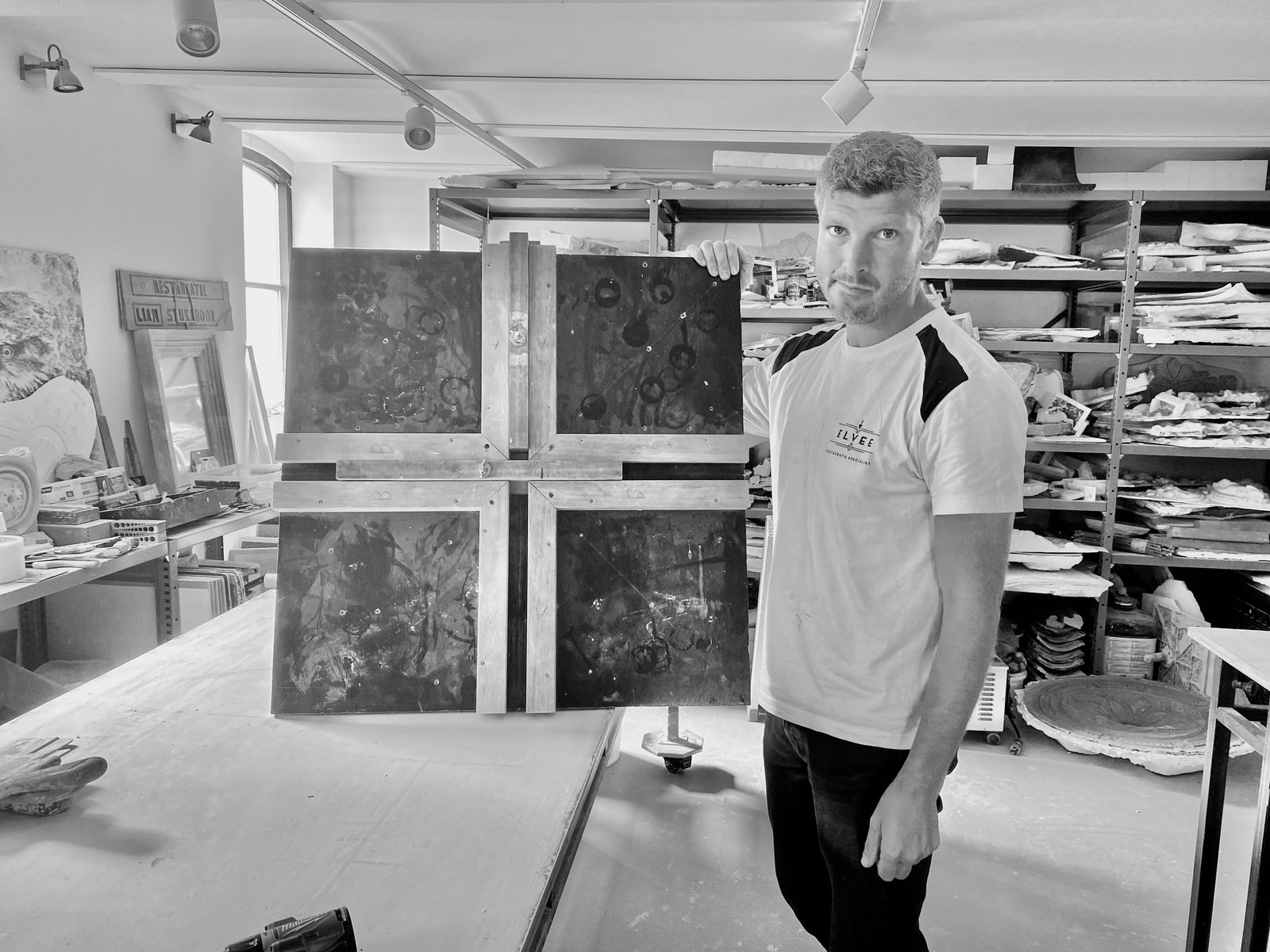
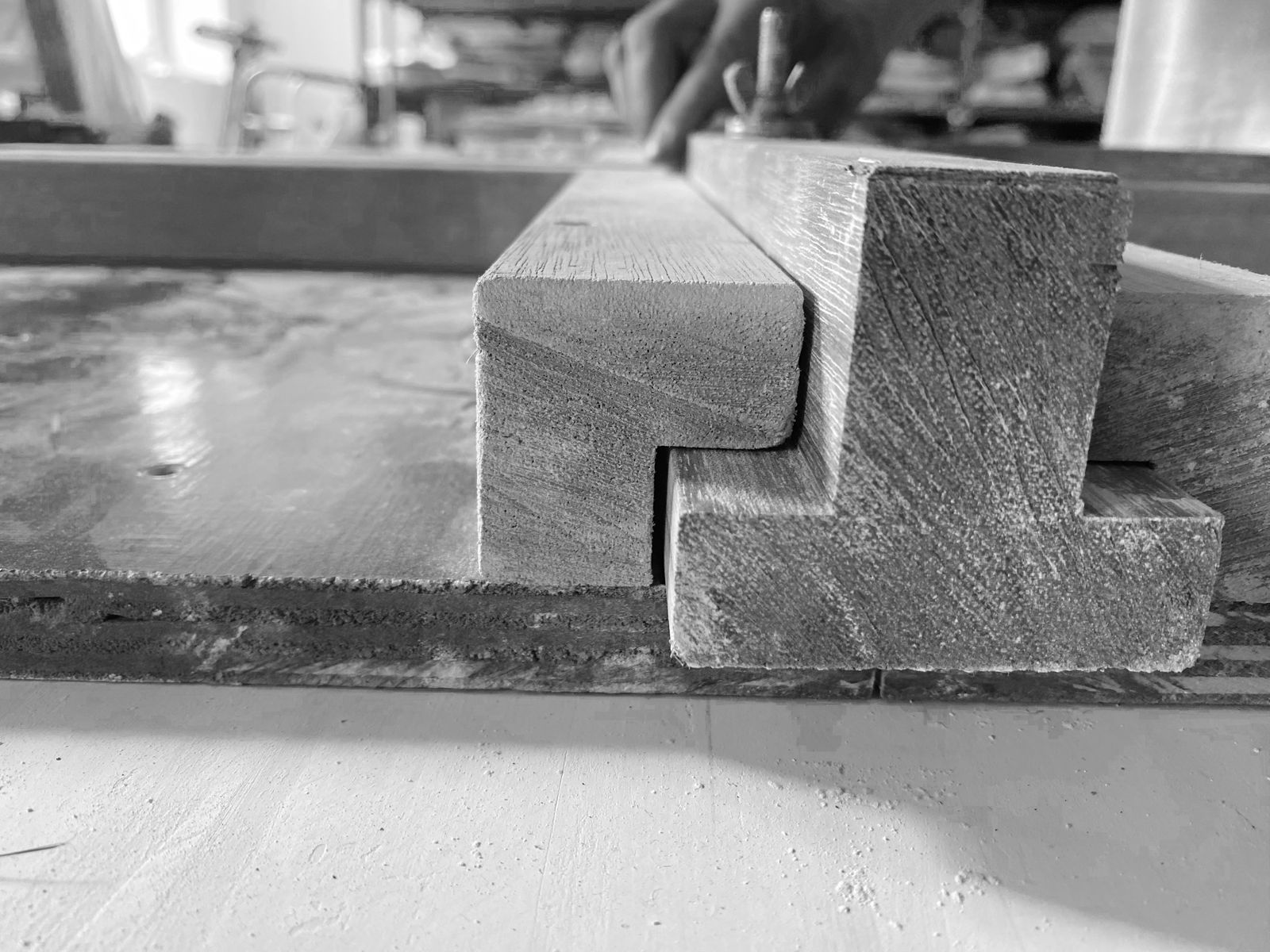
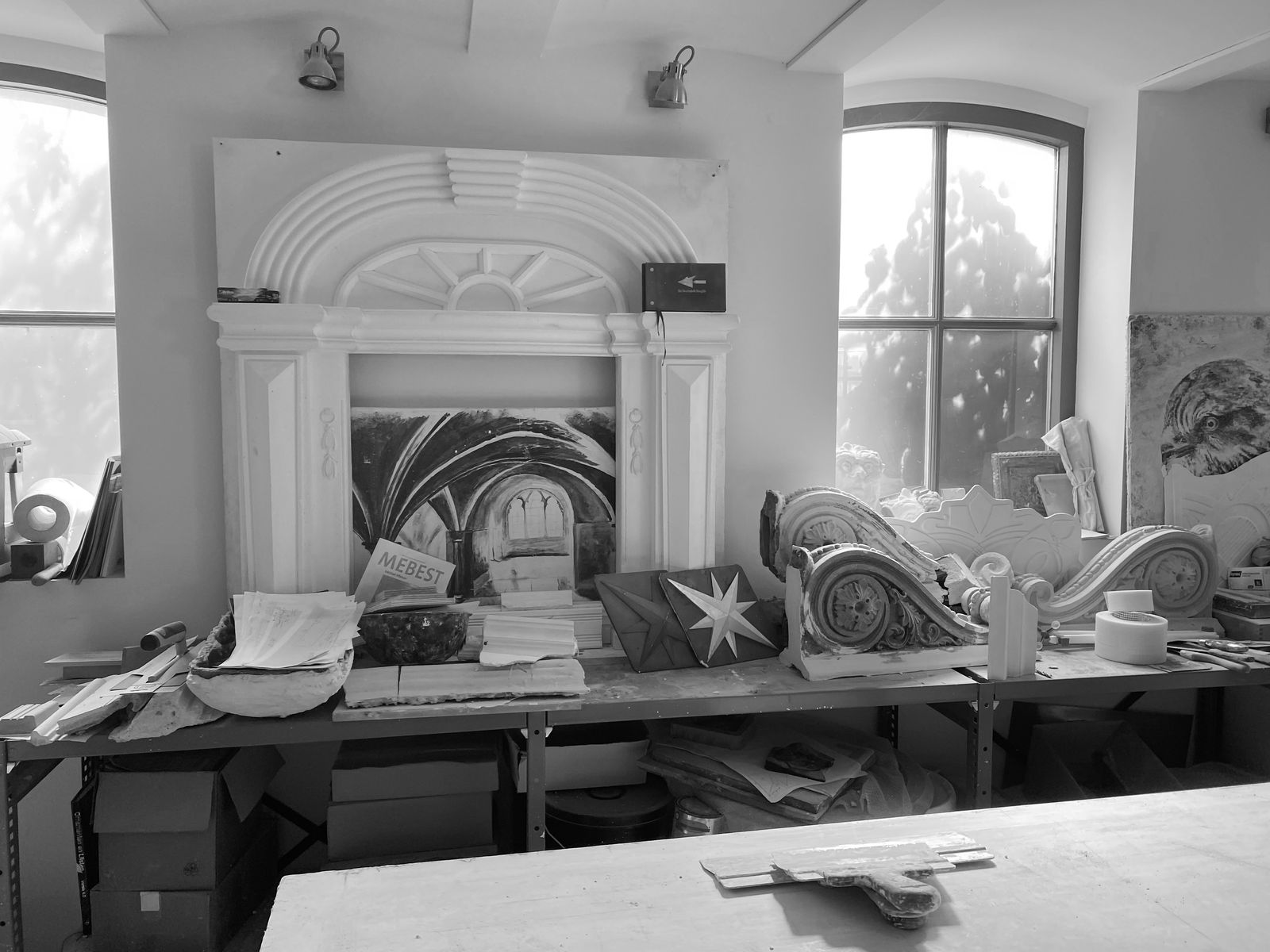
We walk through the studio. A plaster mill. Tools. Test pieces. Molds. Ornaments. Materials that, to an outsider, seem mostly white, but to the craftsman possess a whole world of properties. Then there lies a remarkable wooden tool: the crosscut. You don’t buy it. You make it yourself.
And that’s precisely why such a seemingly simple tool might say more about the craft than a cabinet full of modern machines.
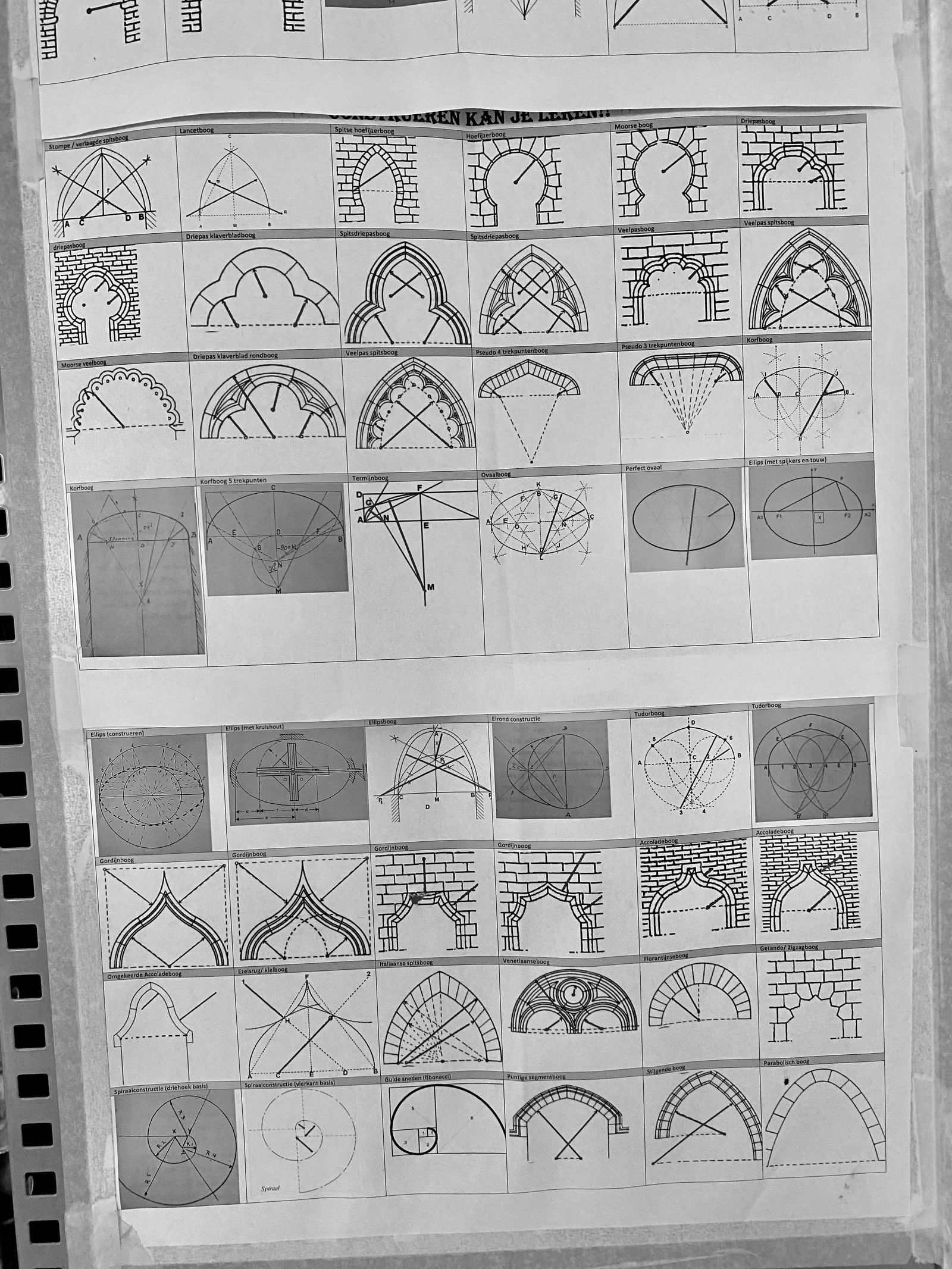
Among other things, the cross-cut jig is used to mark out precise ellipses, for example, for decorative work on a ceiling. The principle is almost beautiful in its simplicity. Two guides are perpendicular to each other. Attached to a moving rod are two fixed points, each of which passes through one of those guides. As the rod moves, one point slides horizontally and the other vertically. As a result, the end of the rod automatically traces a perfect ellipse.
No software. No laser. No algorithm. Just a few pieces of wood and geometry. But you do need to know how large the ellipse should be, where it belongs in the space, what proportions are correct, and what will happen around it afterward. And that’s where Lois’s real advantage begins.
The unfair advantage: seeing what isn’t there yet
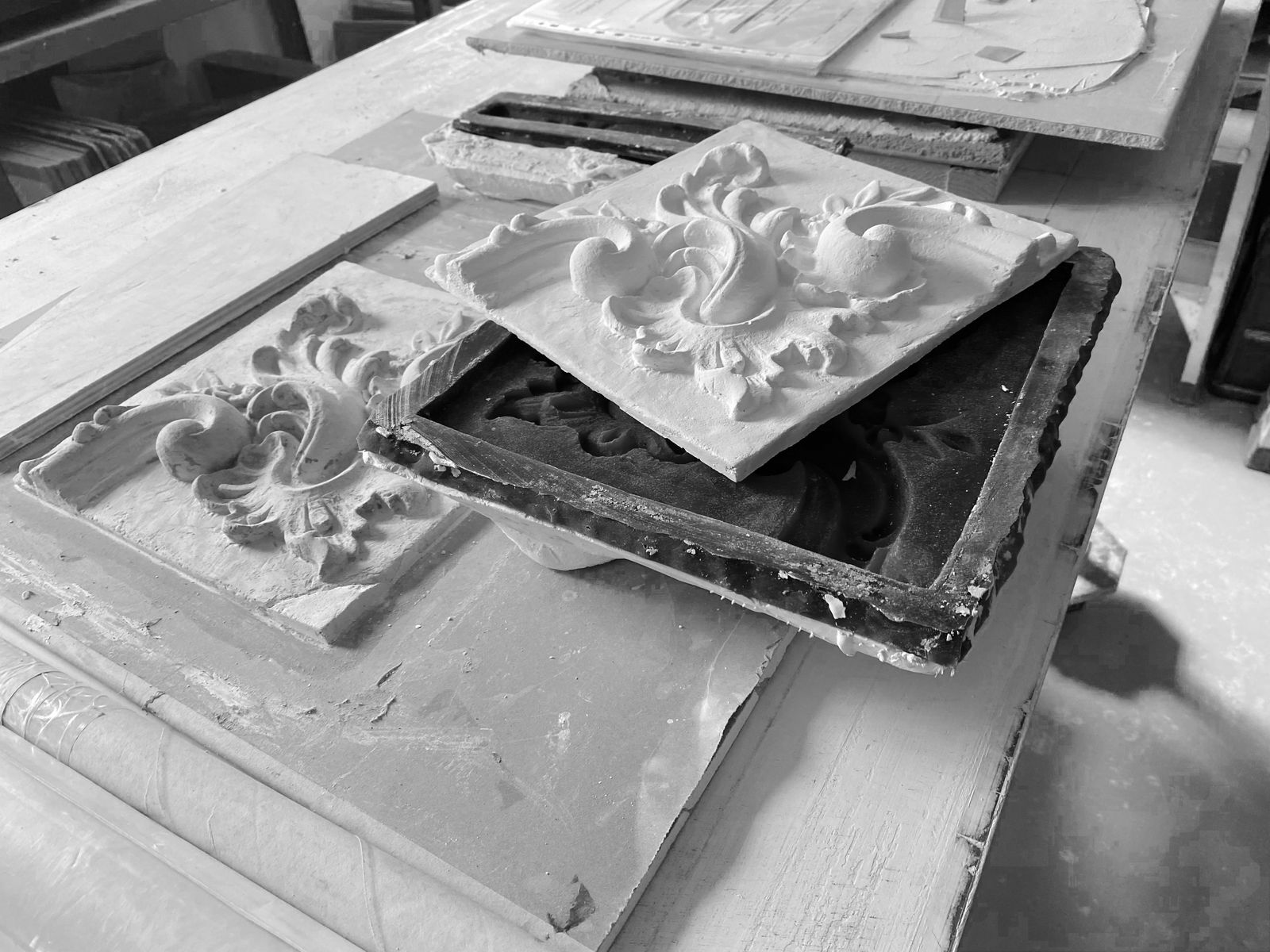
When we ask him what sets him apart from other craftsmen, he doesn’t have to think long. Spatial awareness. At first, that sounds almost too simple—until he begins to explain how moldings, ceilings, ornamentation, walls, windows, and proportions relate to one another. Stucco is never just a molding along a ceiling.
A space has rhythm. Symmetry. Axes. Proportions. An ornament can be beautiful on its own and yet throw an entire room off balance. Traditionally, clients often choose their decorative elements from catalogs. Moldings, rosettes, consoles, and ornaments form the alphabet; the stucco artist crafts the sentence from them. But that is precisely where the difference between execution and design lies. Lois sees combinations before they even exist.
The carpenter’s square is thus more than just a tool. It’s almost a metaphor for how he works: you establish a few fixed points and let a form emerge within them that fits perfectly.
When the Hands Take Over
During the conversation, a question arises that keeps coming up for Oddny whenever we speak with creators: When do your hands actually take over from your mind? Lois recognizes it immediately. Something remarkable happens with stucco work. Mortar isn’t a passive material. Gypsum, lime, and other binders have their own timing, viscosity, temperature, and behavior. The material changes as you work with it.
You sense when it’s ready. You sense when you need to wait. You sense when you’re too late. At a certain level, the plasterer hardly even thinks about it consciously anymore. The hand reacts before the brain can put the action into words. That’s not just romanticizing the craft. It’s knowledge. Only, that knowledge isn’t found exclusively in the head. It’s in the fingers, wrists, shoulders, eyes, and thousands of hours of experience.
Artist, Craftsman, and Entrepreneur
It’s interesting that Lois sees himself first and foremost as a craftsman. His original path, after all, led him through the Willem de Kooning Academy, where he focused on becoming a visual arts teacher. Even while attending the academy, he was already working as a plasterer; in 2006, he founded Elvee Stucwerk. That background turned out not to be a detour from craftsmanship, but rather a reinforcement of it. Observation, composition, proportion, spatial thinking, and the ability to envision a form before it exists: it is precisely this artistic background that makes him exceptionally strong as a specialist.
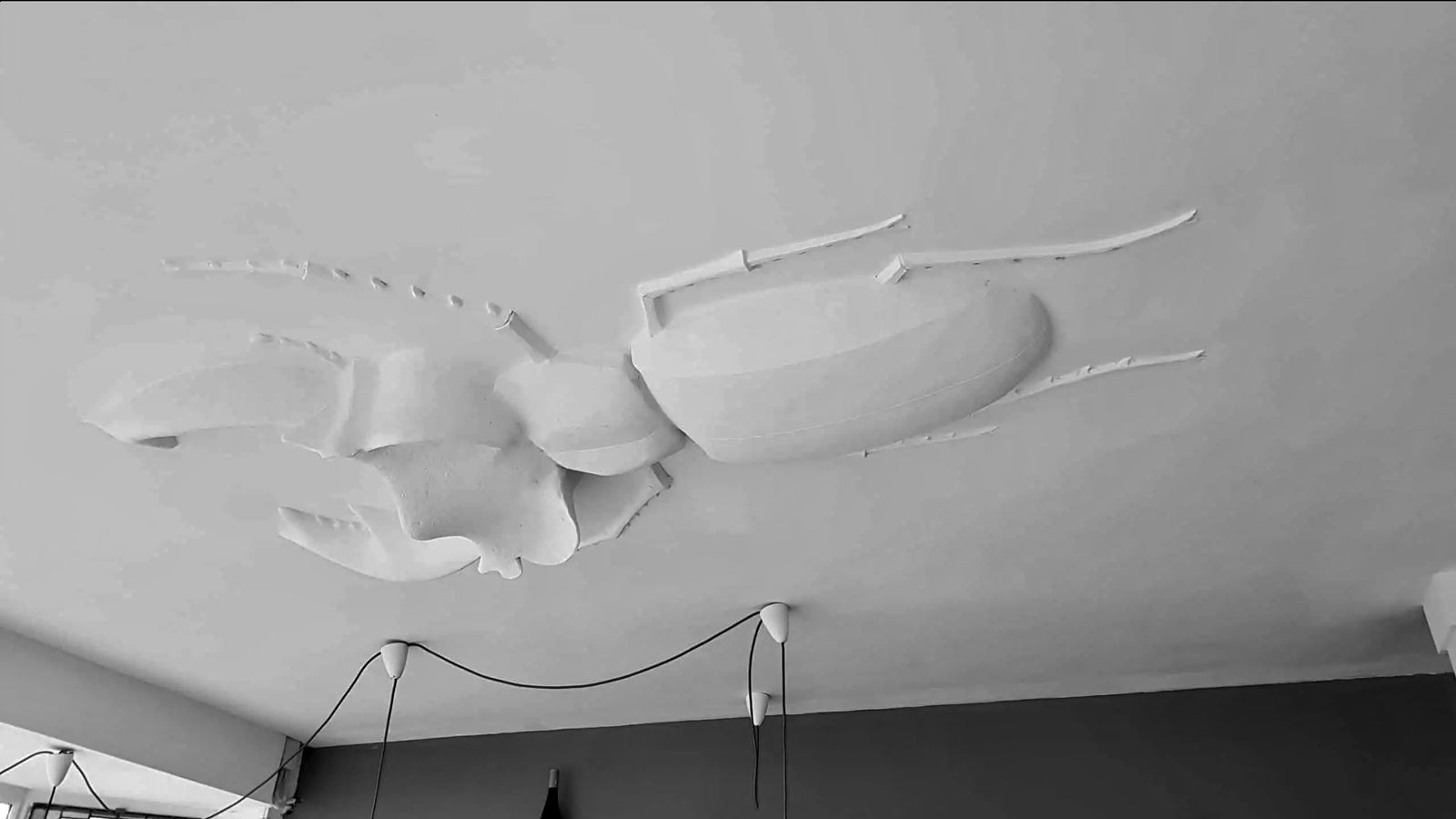
Art and design do not disappear as a result. They simply take on a different role. Lois does not allow himself to be limited by the distinction between artist and craftsman; he uses one to enhance the other. In most of his work, the craft takes precedence. A frame must be just right. A surface must be flawless. Restoration work requires discipline and knowledge, not a need to position yourself as an artist between the building and history. But sometimes a commission comes along where everything comes together. Like a ceiling featuring a stag beetle—that imposing beetle—for a wine bar.
That’s when visual imagination, design, composition, and the plasterer’s craft come together. Not because every ceiling has to become art, but because the craft itself holds that potential.
Restoration is going back in time
Lois’s great passion lies in decorative work and restoration. When it comes to restoration, he follows a clear principle: you try to return to the way something was created at the moment the original work was made. So not: how do we solve this as efficiently as possible today? But rather: How was this originally constructed? What mortar did the builder use? What substrate? What technique? What tools? What does the building itself reveal? This sometimes means revisiting techniques that almost no one knows anymore today.
Until historical reality and common sense clash. Because when it turns out that someone once slid reed stalks one by one into other reed stalks to create a certain structure, you can, of course, decide to reconstruct that method down to the last fiber. You can also conclude that even heritage is occasionally entitled to a bit of practical intelligence. For Lois, therefore, restoration is not a religious reenactment of the past. It is about understanding what the original builder did, why he did it, and then carefully deciding how far back to go.
Hard work requiring great intelligence
Anyone who looks only at the end result easily misses what comes before it. Plastering is physically demanding. Much of the work takes place above shoulder height—on scaffolding, up against ceilings—with buckets and materials that, strangely enough, gravity always seems to have on its side. For certain tasks, Lois uses an exoskeleton to support his arms and shoulders. At the same time, the same trade requires extremely precise calculations. This brings us to a topic that, in creative professions, is remarkably often only discussed after the work is done: money.
Lois regularly works for a fixed fee. You agree in advance on what a project will cost. That sounds straightforward—until a job that’s supposed to take a hundred hours ends up costing a hundred and twenty. The materials aren’t even always the biggest problem; time is.
A few extra days with additional people can easily wipe out the profit margin on a project. Moreover, it’s not always obvious to a client just how much work is hidden behind a few meters of moldings, an ornament, or a restored ceiling. Those who see only the end result see, above all, a beautiful wall. Those who create it see hours of work.
Becoming an entrepreneur without ceasing to be a creator
That tension runs throughout the entire conversation. Lois is a creator, an artist, a craftsman—but also an employer and an entrepreneur. And even there, he doesn’t let his original background limit him. He’s learning to calculate costs, assess risks, manage staff, invest, and plan ahead—not as a necessary evil alongside his craft, but as prerequisites for continuing to create at a high level. As soon as you have employees, risk transforms from an abstract business concept into something very concrete. When an employee falls off a scaffold and is unable to work for an extended period, payroll obligations continue. When a company van needs to be replaced with an electric model, the cost suddenly runs into tens of thousands of euros. When a restoration project, while opening up a building, reveals something completely different from what anyone expected, a careful cost estimate turns into a financial challenge within a few days.
Craftsmanship alone won’t protect you from that. This is precisely where Lois becomes an interesting example for other creators: artistic and craft-based autonomy become stronger when you also understand the business side of what you do. For him, entrepreneurship isn’t at odds with creation; it enables continuity, freedom, and quality.
 The Most Dangerous Moment: When the Money Comes In
Lois sees yet another risk for new self-employed individuals. The first invoices get paid. Suddenly, there’s money in the account. That feels fantastic. And that’s exactly where the danger lies. Because not all of that money is yours. The tax authorities come calling. Supplies need to be paid for. The van costs money. Tools wear out. A job runs over schedule. A client pays later than expected. An entrepreneur who looks only at his bank balance may therefore count himself rich with money that has, in fact, already been earmarked for various purposes. According to Lois, those just starting out often have little idea of what’s in store for them. That’s not a lack of intelligence. No one starts a creative or craft-based profession because they dream of cash flow planning, tax reserves, and disability risk. But sooner or later, they all find themselves facing the same challenges.
Insuring What Is Hardly Insurable
That brings us to disability insurance. Lois is critical. He argues that anyone who truly wants to fully insure their income as a self-employed professional will end up with premiums that are hardly attractive or affordable for many entrepreneurs. As a result, a policy may suggest security while the actual coverage is much more limited than one might think. His alternative is a collective approach: if policymakers truly want to protect the self-employed against disability, they should organize a broad fund in which the self-employed participate collectively.
You may or may not agree with his analysis, but the underlying problem is real: it is precisely those who literally earn their income with their bodies who keenly feel how directly health, work, and financial stability are interconnected. A designer might still be able to sit at a laptop with a broken leg. A plasterer who can’t use his arm has a different problem.
A House as a Thesis
Then there’s the house. Lois and his family bought it as a dilapidated ruin and worked on it for about seven years. Anyone who expects a plasterer to want to see absolutely no more plasterwork at home after a full workweek doesn’t know Lois. The house almost turned into a personal laboratory. Walls of hemp lime, Art Nouveau ornamentation, beveled window frames, and all kinds of techniques come together. Not as a showroom where every little trick demands separate attention, but as proof that materials, architecture, and craftsmanship can form a single whole.
Perhaps the most striking thing isn’t even the house itself. It’s Lois himself. Working six days a week. Teaching. Running a business. Carrying out projects. Restoring. A family. Renovating a house. And on top of that, he has been chairman of the Neerlandsch Stucgilde for four years—a role he is expected to fulfill for another term. His chairmanship is also featured in the Guild’s anniversary publication. Yet the man sitting across from us doesn’t look like he desperately needs a three-month vacation. On the contrary. He’s bursting with energy.
The energy of a dream come true
Perhaps that is ultimately the crux of the matter. Work takes energy. But work can also give energy back. When what you do aligns with what you want to be able to do, what you want to learn, and what you want to achieve, the nature of that effort changes. Lois is realizing a dream and then keeping it alive. Not by achieving it once, but by carrying it out anew every single day.
In plaster. In chalk. In a student who discovers on a Saturday how an old technique works. In an ornament that reappears where it has been missing for decades. In a homemade piece of wood that lets you draw a perfect ellipse. He wants to keep at it. Until he collapses. Coming from Lois, that doesn’t sound dramatic. More like a plan.
AI? A tool, not a replacement
Of course, AI comes up as well. Lois isn’t afraid of it. Maybe AI will become a handy tool. For designs, visualizations, measurements, preparation, or to explore variations more quickly. Like so many new techniques, it can expand the craftsman’s toolkit. But the craft itself won’t disappear because of it.
Plastering a ceiling is still plastering a ceiling. Mortar must be mixed, applied, felt, and worked at exactly the right moment. An ornament must fit the space. In restoration, you have to see on the spot what’s hidden beneath a layer of paint or plaster. No model can sense the resistance of wet lime in a trowel. AI might be able to help come up with ideas for how something could be done. Lois still has to make it. And perhaps that’s a comforting thought. The smarter our digital tools become, the more visible the difference becomes between information and mastery—between knowing what an ellipse is and being able to draw it perfectly on a ceiling.
It remains a craft.
Why This Matters
We talk a lot about the knowledge economy, AI, innovation, and new technology. This sometimes creates the impression that progress mainly takes place on a screen. Lois actually views technology very differently: the way a craftsman views every new tool. If it helps, you use it. But ultimately, someone still has to be up on the scaffolding. Here, too, knowledge lies in a hand. In the resilience of mortar. In a glance at a ceiling. In the ability to interpret a damaged ornament. In knowing which millimeter matters and which doesn’t. And above all, in the fact that that knowledge takes time.
You can speed up access to information. You can digitize a manual. You can generate an image and have software calculate a structure. But you can’t download nine years of experience. That’s perhaps what makes craftsmanship extraordinarily modern. In a world where almost everything can be done faster, the value of things that can only be perfected slowly increases. And isn’t that precisely Lois Vlasblom’s Proof of Genius: not that he works with his hands, but that his hands now know what to do before he has to explain it.
https://elveestucwerk.nl/